





Google search doesn’t look like it used to. If you are still managing your law firm’s website using a 2022 SEO playbook, you are likely optimizing for a version of the internet that no longer exists.
Today, traditional organic search results are being pushed beneath massive, AI-generated summaries. At the same time, potential clients are bypassing search engines to ask legal questions directly to conversational AI platforms such as ChatGPT, Claude, and Perplexity.
As artificial intelligence reshapes how people find legal representation, two new acronyms have quickly replaced traditional SEO at the forefront of digital strategy: AIO (AI Optimization) and GEO (Generative Engine Optimization).
At White Rabbit Marketing, we help forward-thinking firms peek behind the curtain of emerging technology. Let’s dive into what AIO and GEO mean for your law firm website, how they differ, and how you can optimize your content to ensure your firm gets cited, trusted, and hired.
The New Pillars of Legal Marketing: AIO vs. GEO
While traditional SEO focused on hacking keyword density and building backlink volume to please search engine algorithms, AIO and GEO are entirely focused on how AI systems interpret, synthesize, and cite information.
Though they share a common goal—making your firm visible in an AI-driven landscape—they target two distinctly different types of technology and user behavior.
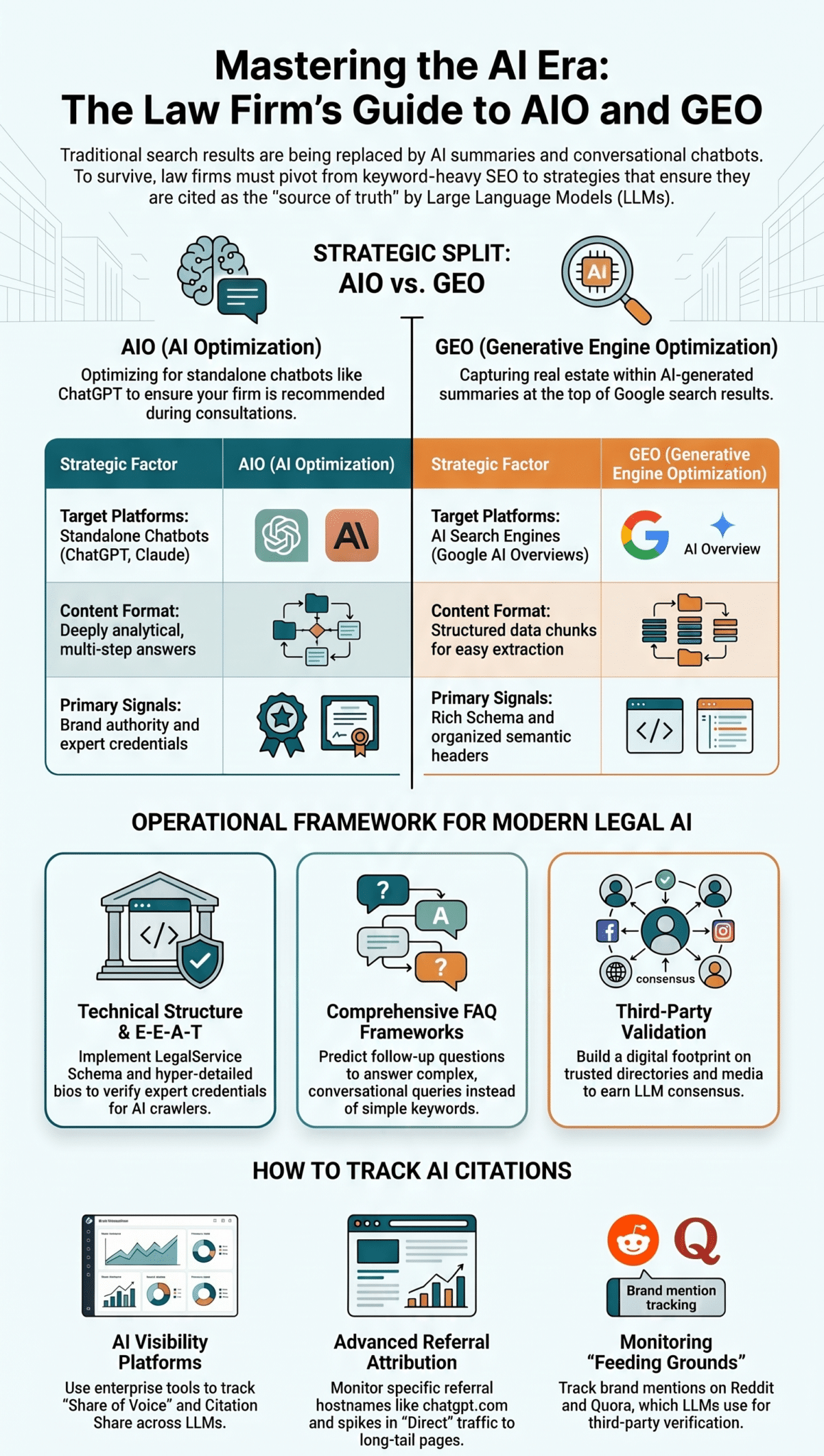
1. AIO (AI Optimization): Capturing the Conversationalist
The Target: Standalone AI chatbots and LLMs (Large Language Models) like OpenAI’s ChatGPT, Anthropic’s Claude, and Perplexity.
AIO is the practice of structuring your website’s information so that chatbot ecosystems recognize your firm as a premier authority. When a user asks ChatGPT, “I was in a car accident in Austin; how is pain and suffering calculated?” or “Can you recommend a reputable business litigation firm in Chicago?” AIO ensures that the chatbot pulls from your content and explicitly names your firm as a recommended source.
2. GEO (Generative Engine Optimization): Winning the Search Engine Summary
The Target: AI-enhanced search engine feature-sets, most notably Google’s AI Overviews (formerly SGE).
GEO is designed to capture real estate within the AI-generated summaries that now dominate the top of Google search results. When potential clients look up legal information, Google’s AI synthesizes data from multiple top-tier web pages into a singular, conversational answer before showing any traditional “blue links.” GEO tactics ensure your website’s content is the exact data source Google uses to build that AI summary.
Strategic Breakdown: How They Compare
Understanding how these two strategies segment the modern client journey is vital for allocating your marketing resources effectively:
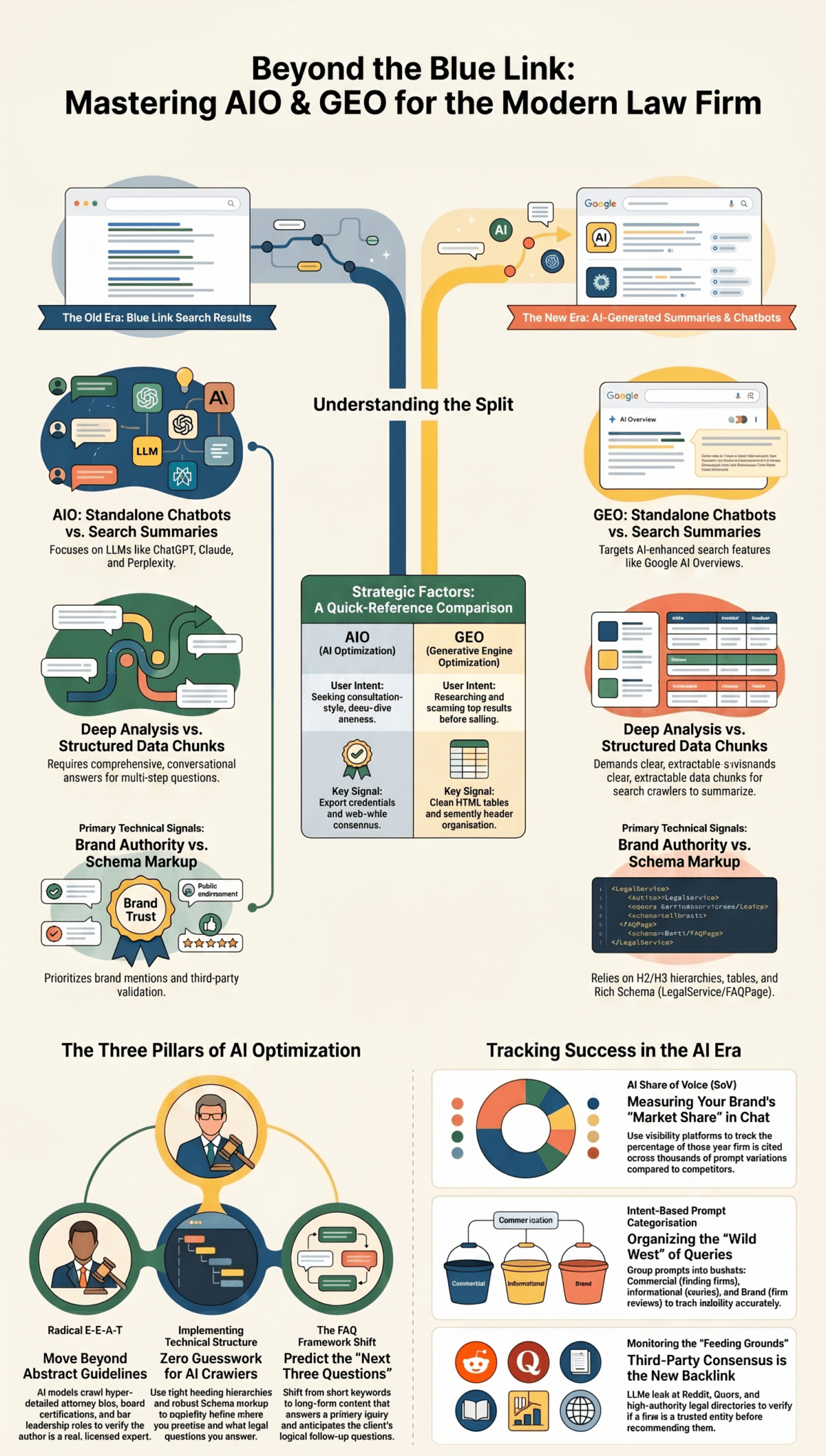
| Strategic Factor | AIO (AI Optimization) | GEO (Generative Engine Optimization) |
| Target Platforms | Standalone chatbots (ChatGPT, Claude, Perplexity) | AI-powered search engines (Google AI Overviews) |
| Content Format | Comprehensive, conversational, and deeply analytical to answer multi-step, contextual questions. | Clear, highly structured data chunks that an AI search crawler can seamlessly extract and summarize. |
| Primary Signals | Heavy emphasis on brand authority, third-party source validation, and verifiable expert credentials. | Rich Schema markup, tightly organized semantic headers (H2s/H3s), and clean table layouts. |
| User Intent | Users seeking consultation-style interactions or deep-dive answers who may never visit a search engine. | Users in research or comparison mode who are scanning top results before making a call. |
How to Optimize Your Law Firm’s Website for AI Search
To win citations in both Google AI Overviews and standalone AI bots, your legal content needs to undergo a paradigm shift. Here is the operational framework for modern legal AI optimization:
Double Down on E-E-A-T
Experience, Expertise, Authoritativeness, and Trustworthiness (E-E-A-T) are no longer just abstract Google guidelines—they are the exact data signals AI systems use to filter out low-quality “noise.”
- Action: Build hyper-detailed attorney bios. Highlight specific case results, board certifications, bar association leadership roles, and published works. AI models crawl these to verify if the author of a legal piece is a real, licensed expert.
Implement Technical Structure and Schema Markup
AI models are highly sophisticated, but they prefer information that requires zero guesswork to parse.
- Action: Use tight heading hierarchies (H2s, H3s) and organize complex data into bulleted lists or HTML tables. Implement robust schema markup (such as LegalService and FAQPage schema) to explicitly tell AI engines who you are, where you practice, and what questions your content answers.
Shift From “Keywords” to “Comprehensive FAQ Frameworks”
Traditional SEO target keywords like “divorce lawyer near me.” AI searchers use natural language queries like, “My spouse hid assets during our marriage in Ohio, what are my legal options?”
- Action: Write long-form content that answers the primary question and predicts the next three logical follow-up questions a client might ask. Frame your content natively around complex, conversational problem-solving.
Earn High-Authority Third-Party Validation
Chatbots look at the broader web consensus to decide if your firm is safe to recommend. If trusted directories, court websites, bar associations, and local media mention your firm, AI models note that digital footprint.
- Action: Maintain an active PR and local citation strategy. The more your firm is mentioned alongside your practice area online, the more likely ChatGPT is to recommend you.
Keep Content Fresh
Law changes rapidly. AI engines tend to favor fresh content over outdated articles to avoid providing hallucinated or obsolete legal advice.
- Action: Audit and update your main practice area pages and blog posts regularly to reflect recent case law, local statutory adjustments, or shifting legal trends.
Why Your Firm Can’t Choose Just One
When looking at AIO vs. GEO, the goal shouldn’t be to pick one over the other. A successful modern legal practice needs a symbiotic strategy that blends both.
Potential clients don’t follow linear paths anymore. A personal injury client might start on Google, skimming an AI Overview to understand liability rules (a GEO touchpoint). Later, as they think through their specific scenario, they might open ChatGPT to model out a conversational dialogue about dealing with insurance adjusters (an AIO touchpoint).
The ultimate silver lining? High-quality, authoritative legal content natively serves both. When you write content that puts the user’s need for clarity and accuracy first, you organically feed both the search engine scrapers and the LLM training models.
Follow the White Rabbit to the Future of Legal Search
The firms that thrive in this shifting landscape are those that refuse to stay stagnant. Transitioning your website from a passive brochure to an AI-optimized authority hub is the single best way to protect your digital pipeline.
Don’t let your firm get left behind in the old organic results pages. At White Rabbit Marketing, we stay ahead of the technical curves so you can focus on winning cases. Contact us today to audit your firm’s current AI visibility and future-proof your digital strategy.

David Faltz
Latest posts by David Faltz (see all)
- What Happened to Google’s First Page? How AI Is Reshaping Search in Real Time - September 5, 2026
- How AI Decides Which Lawyers and Law Firms to Recommend - July 15, 2026
- How to Build and Optimize a Law Firm Website for the AI Era - July 3, 2026