




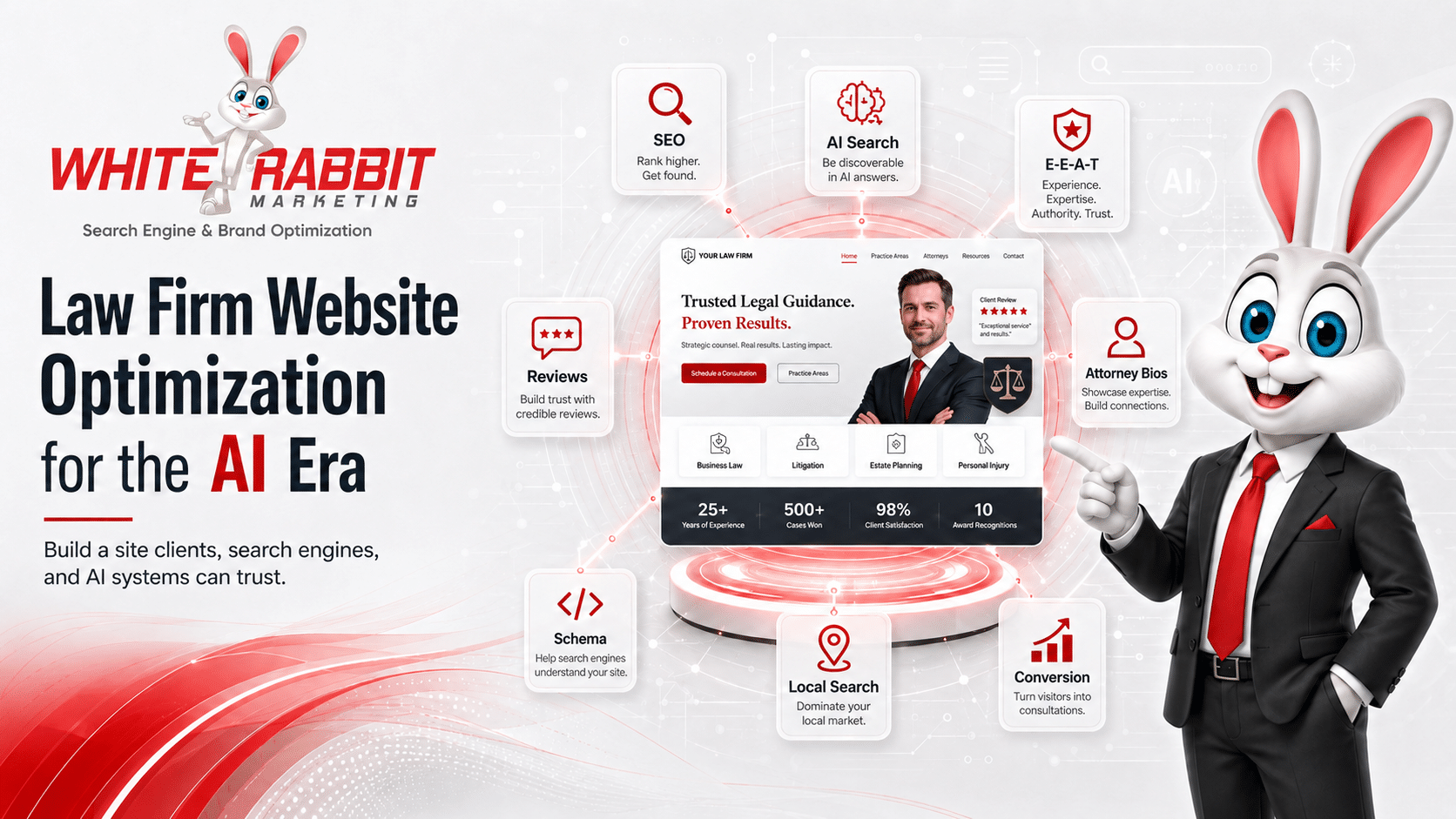
A law firm website is no longer just a brochure or ranking asset. In the AI era, it becomes the firm’s owned authority engine.
For years, most law firm websites were built around a simple goal: rank on Google and turn visitors into leads.
That goal still matters.
But it is no longer enough.
Search is changing. Prospective clients are no longer only typing short keyword phrases into Google and choosing from a list of blue links. They are asking longer, more specific, more personal questions across Google AI Overviews, ChatGPT, Gemini, Perplexity, Reddit, legal directories, review platforms, and social media.
They are not just searching for “lawyer near me.”
They are asking:
- Do I need a lawyer for this?
- How do I know if a lawyer is good?
- What happens after I get arrested?
- Should I talk to the insurance company?
- How does custody work if both parents disagree?
- What happens if my visa is denied?
- Do I need a trust or is a will enough?
- Can I sue if someone breached a contract?
- Which lawyer is most trusted for this situation?
That shift changes what a law firm website needs to do.
A modern law firm website is no longer just a brochure. It is no longer just a ranking asset. It is no longer just a collection of practice-area pages and contact forms.
In the AI era, a law firm website has to become the firm’s owned authority engine.
It needs to help clients, search engines, and AI systems understand who the firm is, what it does, where it practices, what problems it helps solve, why its attorneys are qualified, and whether the broader web appears to trust it.
That is the new job of law firm website optimization.
The Law Firm Website Is Still the Center of Digital Authority
There is a lot of conversation right now about AI search, Reddit, LinkedIn, Google Business Profile, reviews, legal directories, and third-party authority signals.
All of those matter.
But none of them replaces the law firm website.
The website is still the firm’s owned source of truth. It is the place where the firm can explain its services, introduce its attorneys, answer client questions, publish original insight, organize its practice areas, connect its locations, and guide visitors toward consultation.
A Google Business Profile can show reviews and contact details.
A legal directory can validate credentials.
A Reddit thread can reveal what people are asking.
A LinkedIn profile can strengthen professional identity.
An AI search result can summarize information from across the web.
But the law firm website should be the central place where all of those signals are reinforced.
If the website is weak, thin, outdated, slow, generic, or confusing, the rest of the firm’s digital presence becomes harder to trust.
If the website is strong, clear, useful, and well-structured, every external signal has a better place to point to.
That is why the website still matters in the AI era.
Not because everything begins and ends with the website.
But because the website is the authority hub that helps the rest of the digital ecosystem make sense.
What AI Search Changes About Law Firm Website Strategy
Traditional legal SEO often focused on ranking pages for specific keywords.
That still matters, but AI search adds a new layer.
Google has said that its AI experiences in Search are still built on many of the same foundational principles as regular Search, including crawlability, page experience, visible text, internal links, and structured data that matches visible page content. You can see this in Google’s guidance on AI features and your website.
But AI systems are not simply looking for pages that mention a keyword. They are trying to understand relationships, entities, context, credibility, usefulness, and corroboration.
For a law firm, that means the website needs to answer questions like:
- Who are the attorneys?
- What does the firm actually do?
- Where does the firm practice?
- What types of cases does the firm handle?
- What legal issues is the firm associated with?
- Does the site provide helpful explanations?
- Are the attorney’s credentials and experience clear?
- Are practice areas connected in a logical way?
- Do third-party sources support the firm’s authority?
- Is the information trustworthy enough for high-stakes legal questions?
This is especially important because legal content is high-stakes. A person facing a criminal charge, injury claim, custody dispute, immigration problem, probate issue, employment dispute, or business conflict needs information that is careful, accurate, practical, and grounded in real professional understanding.
Generic content is not enough.
A law firm website should not read like it was assembled from interchangeable SEO templates. It should show the firm’s real perspective, real practice focus, real attorneys, real location, and real understanding of what clients are going through.
AI-era optimization is not about stuffing more keywords into a page.
It is about making the firm easier to understand, verify, trust, and recommend.
The AI-Era Law Firm Website Stack™
At White Rabbit Marketing, we think about modern law firm websites through a framework we call The AI-Era Law Firm Website Stack™.
The idea is simple: a law firm website needs multiple layers working together.
A beautiful design without authority will not be enough.
A technically sound site with thin content will not be enough.
A large blog without an attorney identity will not be enough.
A schema without visible substance will not be enough.
Strong SEO without trust will not be enough.
To perform in the AI era, the website needs to combine technical structure, entity clarity, topical depth, trust signals, conversion strategy, and AI visibility.
The stack has six layers:
- Technical Foundation
- Entity Foundation
- Topical Authority
- Trust Signals
- Conversion Layer
- AI Visibility Layer
Each layer supports the others.
Together, they turn the law firm website from a digital brochure into an authority engine.
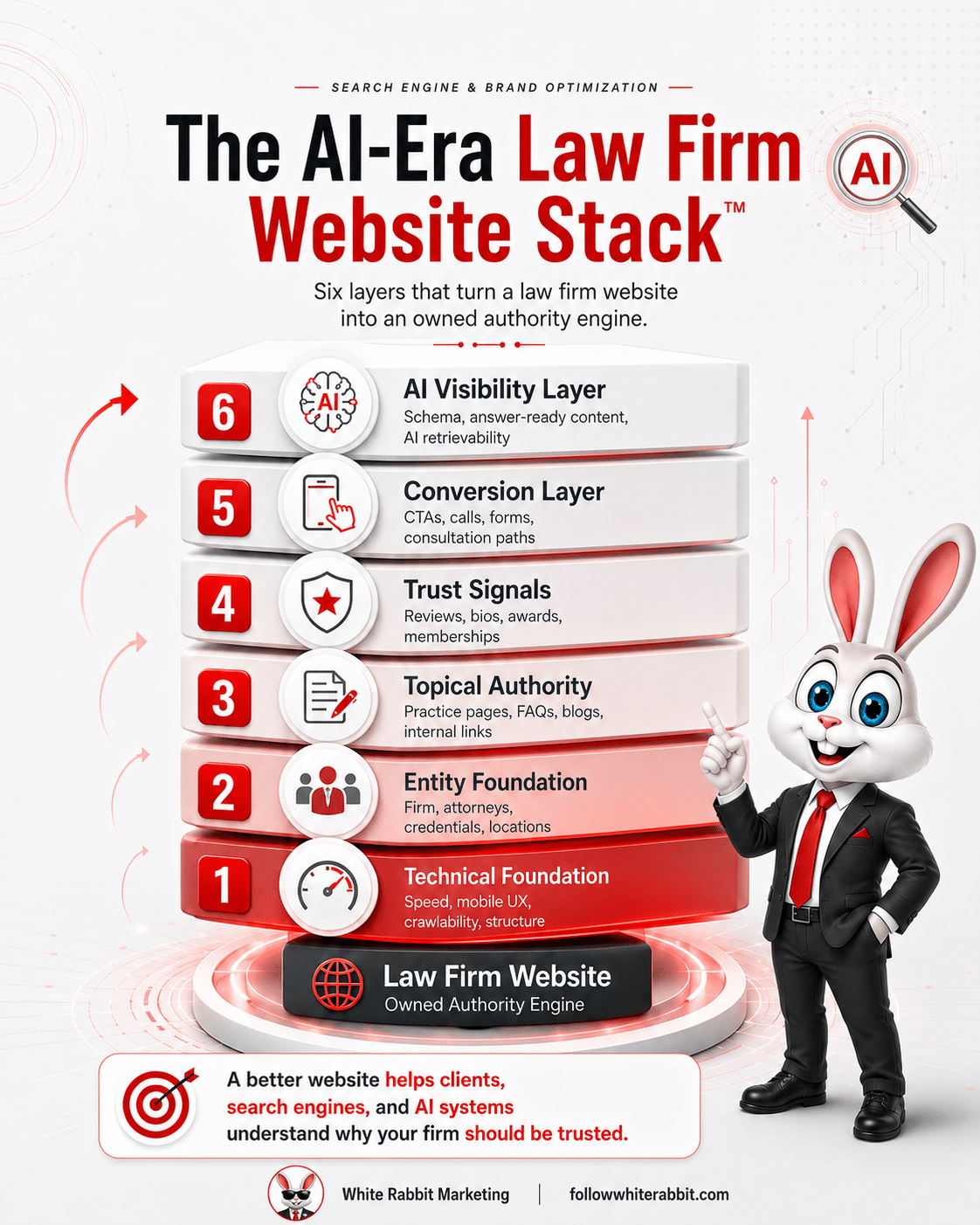
The AI-Era Law Firm Website Stack™ outlines the six layers that enable a law firm website to support clients, search engines, and AI systems.
Layer 1: Build the Technical Foundation First
Before a law firm worries about AI visibility, it needs a technically healthy website.
Search engines and AI systems cannot properly evaluate a site that they cannot crawl, understand, or access.
The technical foundation includes:
- Crawlable pages
- Clean site architecture
- Logical navigation
- Fast loading speed
- Mobile-friendly design
- Secure HTTPS
- Clean URLs
- Proper indexation
- Internal links
- Accessible content
- Optimized images
- Working forms and calls to action
- No major broken links or dead pages
This may sound basic, but many law firm websites still have technical issues that undermine visibility and trust.
Some have outdated themes or page builders that slow down the site.
Some have duplicate or thin pages targeting every nearby city without adding meaningful local value.
Some have buried practice-area pages that are hard for users and crawlers to find.
Some rely too heavily on images, sliders, or design elements that make the page look polished but do little to explain the firm’s authority.
Some have blog content that is technically live but disconnected from the rest of the site.
In the AI era, technical SEO is not going away.
It is becoming the foundation for everything else.
If the site is hard to crawl, hard to navigate, hard to read, or hard to use, the firm’s authority signals are weaker before the content is even evaluated.
Layer 2: Make the Firm and Attorneys Easy to Understand
Law firm SEO has historically focused heavily on practice areas and locations.
That is still important.
But AI-era optimization also requires strong clarity of entities.
In plain English, the website needs to make it obvious who the firm is, who the attorneys are, what they are known for, where they practice, and how everything connects.
This starts with the basics:
- Firm name
- Attorney names
- Professional headshots
- Attorney bios
- Practice areas
- Office locations
- Contact information
- Bar admissions
- Credentials
- Professional memberships
- Awards or recognitions, when legitimate and relevant
- Media mentions, if available
- Author pages
- Consistent business information
- Links to authoritative profiles
Attorney bio pages are especially important.
Too many law firm websites treat attorney bios as thin resume pages. In the AI era, attorney bios should do more.
A strong attorney bio should explain:
- Who does the attorney help
- What types of cases does the attorney handle
- What jurisdictions or courts are relevant
- What experience or background supports the attorney’s authority
- What the attorney’s approach is
- What topics is the attorney qualified to discuss
- Where else can the attorney be verified online
This helps prospective clients, but it also helps search engines and AI systems connect the attorney to specific legal topics, locations, and areas of expertise.
The same principle applies to the firm as a whole.
A law firm website should not make AI systems guess whether the firm is a criminal defense firm, personal injury firm, family law firm, immigration firm, estate planning firm, employment firm, business law firm, or general practice firm.
It should be clear.
It should be consistent.
It should be reinforced across the site.
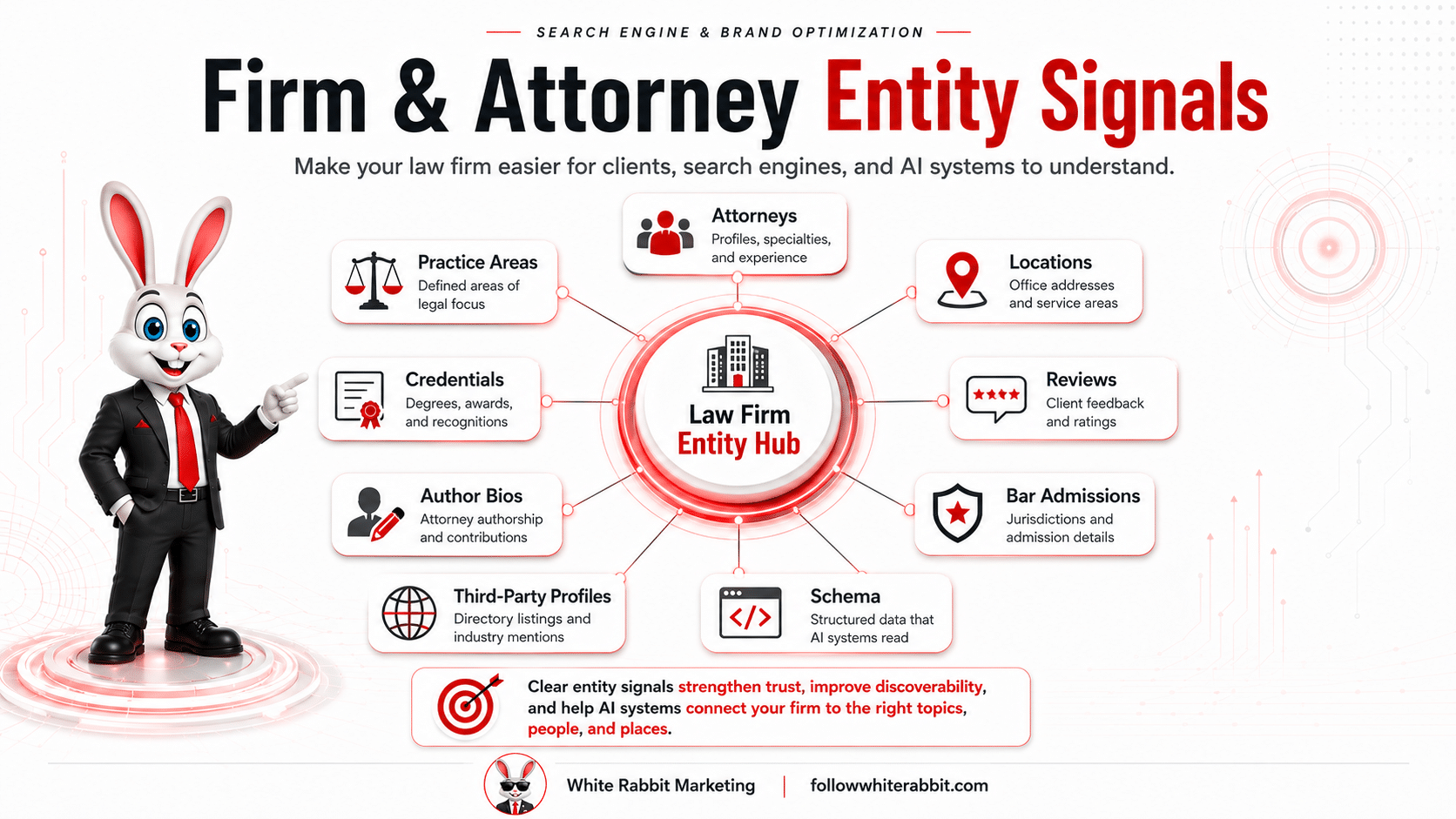
A law firm’s website should clearly connect attorneys, practice areas, locations, credentials, reviews, and schema so search engines and AI systems can better understand and trust the firm.
Layer 3: Build Practice-Area Pages Around Problems, Not Just Keywords
A strong practice-area page should not be built only around a keyword.
It should be built around the client’s problem.
An old-school SEO page might focus on repeating a phrase like “DUI lawyer,” “car accident lawyer,” “divorce lawyer,” or “estate planning attorney.”
A stronger AI-era page answers the questions someone actually has before contacting a lawyer.
A DUI defense page should answer questions about arrest, license consequences, court dates, testing, penalties, defenses, prior convictions, and immediate next steps.
A personal injury page should explain medical treatment, insurance adjusters, liability, damages, deadlines, settlement value, recorded statements, and what happens if the injured person was partly at fault.
A family law page should explain custody, parenting time, child support, property division, protective orders, mediation, emergency issues, and what documents a client should prepare.
An immigration page should explain eligibility, applications, interviews, denials, delays, work authorization, status issues, and how mistakes can affect the case.
An estate planning or probate page should explain wills, trusts, powers of attorney, probate administration, guardianship, asset protection, beneficiary issues, and what happens when someone dies without a plan.
A business or employment law page should explain contracts, disputes, noncompetes, severance, discrimination, wage claims, partnership conflicts, and what business owners or employees should do before taking action.
The goal is not to make every page longer for its own sake.
The goal is to make every page more complete, more useful, and better aligned with how real clients think.
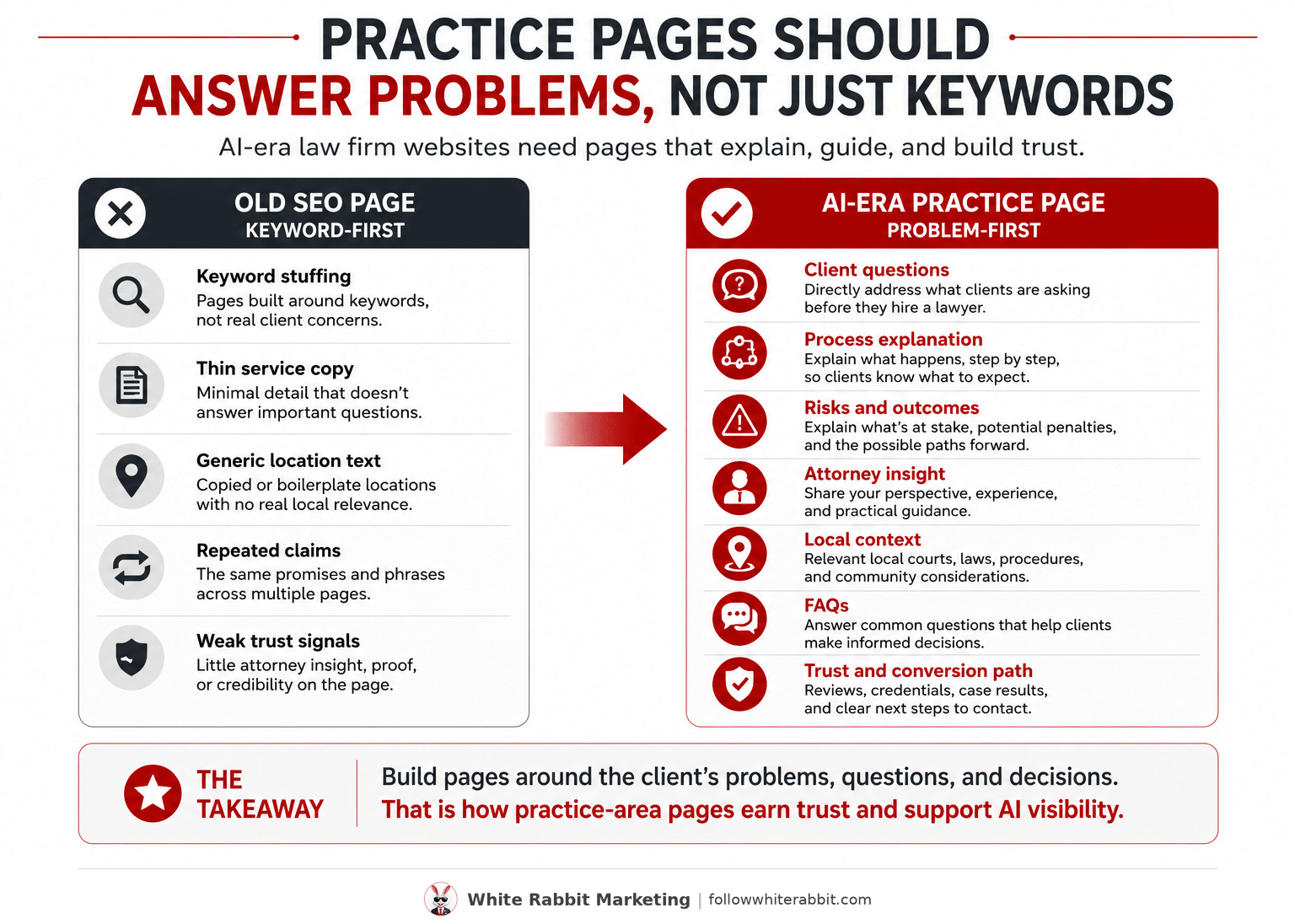
AI-era practice-area pages should be built around the client’s problems, questions, and decisions — not just keywords.
Practice-area pages should answer questions, reduce uncertainty, build trust, and show why the firm understands the situation.
That is very different from simply placing keywords in headings.
Layer 4: Build Topical Authority Across the Whole Site
One strong page is rarely enough.
A law firm website should build topical authority through connected content.
That means practice-area pages, FAQ hubs, blog posts, attorney bios, case result pages, where appropriate, testimonials, location pages, and educational resources should support one another.
For example, a criminal defense website might have:
- A main criminal defense page
- A DUI/DWI practice page
- A domestic violence defense page
- A drug crimes page
- A theft crimes page
- A probation violation page
- A criminal defense FAQ hub
- Blog posts answering specific arrest and court process questions
- Attorney bios showing criminal defense experience
- Internal links connecting related topics
- Schema clarifying page types and entities
A personal injury website might have:
- A main personal injury page
- A car accident page
- A truck accident page
- A motorcycle accident page
- A premises liability page
- A catastrophic injury page
- A personal injury FAQ hub
- Blog posts answering insurance, medical treatment, settlement, and fault questions
- Attorney bios showing injury litigation experience
- Internal links connecting injuries, accident types, and client concerns
A family law website might have:
- A main family law page
- A divorce page
- A child custody page
- A child support page
- A property division page
- A protective order page
- A family law FAQ hub
- Blog posts answering process, timelines, and documentation questions
- Attorney bios showing family law experience
- Internal links connecting related issues
This creates a stronger content ecosystem than isolated pages.
The site begins to teach both users and search engines what the firm is about.
Internal linking is critical here.
A blog post about what happens at an arraignment should link to relevant criminal defense pages.
A post about dealing with an insurance adjuster should link to the personal injury page.
A custody FAQ should link to the child custody practice page.
An estate planning article about trusts should link to the trust planning page and the attorney bio.
An attorney bio should link to the practice areas the attorney handles.
A practice-area page should link to supporting resources that answer deeper questions.
This is not just for SEO.
It is for understanding.
When the content architecture is strong, the site becomes easier to navigate, crawl, interpret, and trust.
This is also where website content marketing goes beyond blogging. It becomes the system that connects client questions, attorney authority, practice-area depth, and conversion intent.
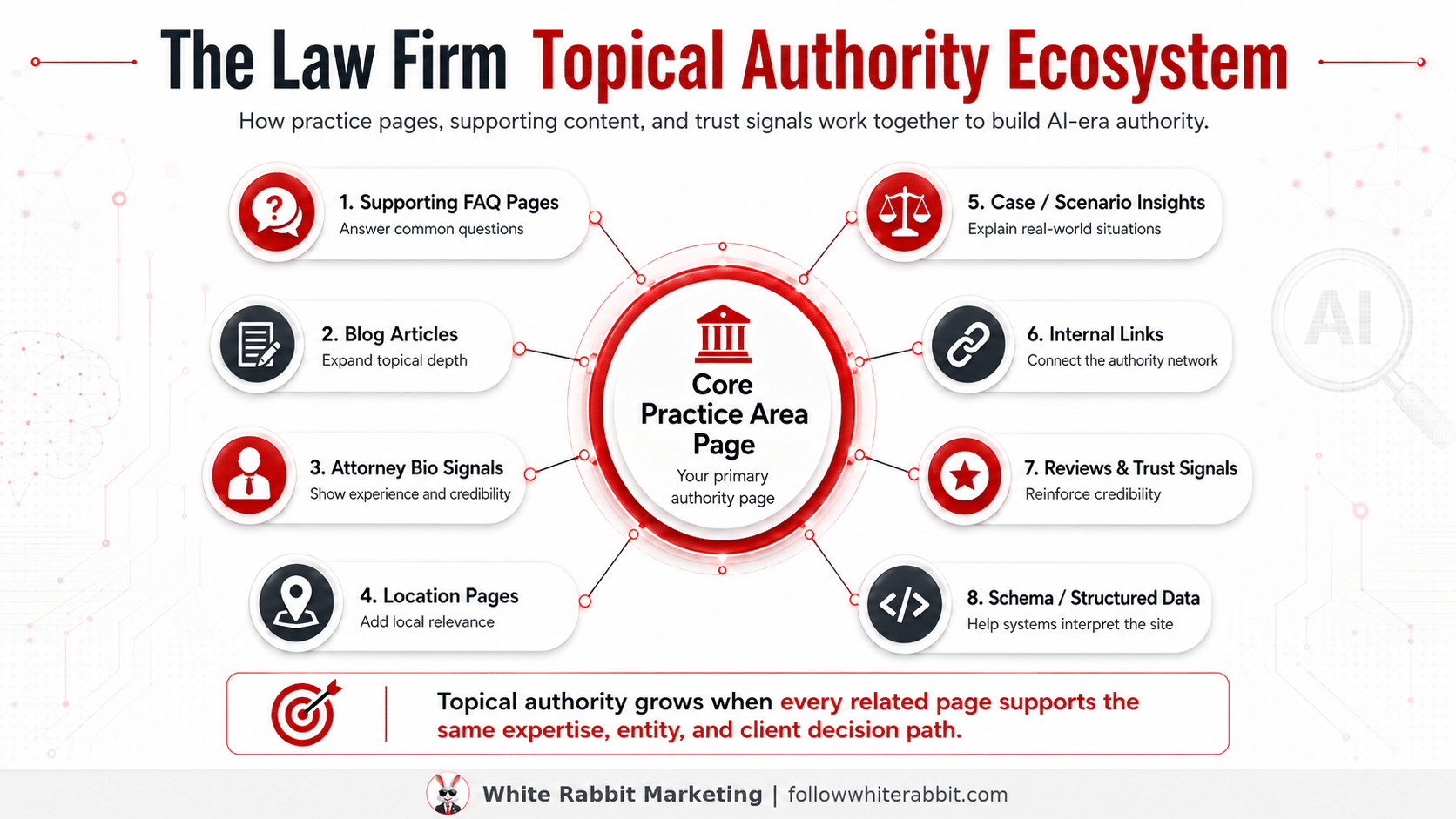
Topical authority grows when a law firm’s core practice-area page is reinforced by related content, trust signals, and internal connections.
Layer 5: Use Trust Signals Throughout the Website
Trust cannot be treated as a small badge on the homepage.
It needs to be woven throughout the law firm website.
Clients need trust signals because hiring a lawyer is a high-stakes decision.
Search engines and AI systems need trust signals because legal information can affect a person’s rights, money, freedom, family, business, immigration status, or future.
Trust signals may include:
- Detailed attorney bios
- Professional headshots
- Reviews and testimonials, where ethically allowed
- Case results, where appropriate and compliant
- Awards and recognitions
- Bar admissions
- Professional memberships
- Media appearances
- Speaking engagements
- Publications
- Community involvement
- Clear disclaimers
- Transparent contact information
- Office location details
- Consistent name, address, and phone information
- Links to authoritative profiles
The key is that these signals should support the page’s substance.
A criminal defense page should not only say the firm handles serious charges. It should explain the risks, process, defense approach, and why early legal guidance matters.
A personal injury page should not only say the firm fights insurance companies. It should explain evidence, damages, treatment, deadlines, and how the lawyer helps protect the claim.
A family law page should not only list divorce and custody. It should show that the firm understands emotional pressure, financial risk, parenting concerns, and the need for practical guidance.
An estate planning page should not only list wills and trusts. It should explain how planning protects families, reduces confusion, and helps clients make informed decisions.
An attorney bio should not only list credentials. It should help a potential client understand whether that attorney is the right person for the problem.
Trust is not one element.
It is the combined effect of clarity, credibility, consistency, design, content, reviews, attorney identity, and third-party validation.
Layer 6: Design for Conversion and Confidence
A law firm website can have excellent content and still fail if the design does not build confidence.
Design is not just decoration.
Design affects trust.
A visitor may not consciously evaluate typography, spacing, mobile layout, page hierarchy, CTA placement, or visual consistency. But they feel the result.
A dated website can make a strong firm appear behind the times.
A cluttered website can make the firm feel disorganized.
A slow website can make the visitor leave before reading.
A generic stock-photo-heavy website can make the firm feel interchangeable.
A confusing mobile experience can cost the firm a consultation.
In the AI era, design and UX matter because a visitor who does click through from search, AI, maps, Reddit, or a directory may already be comparing the firm against multiple options.
The website needs to quickly answer:
- Am I in the right place?
- Does this firm handle my problem?
- Does this firm serve my area?
- Do these attorneys seem credible?
- What should I do next?
- How do I contact them?
- Can I trust them with something this important?
Strong law firm website design should make those answers obvious.
That means:
- Clear headlines
- Strong practice-area navigation
- Visible phone number
- Mobile-friendly calls to action
- Fast-loading pages
- Clean attorney presentation
- Helpful page structure
- Trust-building visuals
- Clear consultation pathways
- No unnecessary friction
The best law firm websites do not just look modern.
They reduce anxiety.
They guide decisions.
They help people take the next step.
Layer 7: Use Schema to Clarify, Not Manipulate
Structured data can help search engines understand the content and entities on a website.
But schema should not be treated like a trick.
It should clarify what is already true and visible on the page.
Google’s documentation explains that structured data can help Google understand page content and qualify pages for certain search features. The important point for law firms is that structured data should support the page’s actual content, not decorate thin or misleading pages. You can review Google’s introduction to structured data for Google Search.
For law firms, schema may help identify:
- The law firm or legal service entity
- Attorneys
- Office locations
- Articles or blog posts
- FAQ sections
- Breadcrumbs
- Organization information
- Author relationships
The important point is that schema should match the page.
If a page has visible FAQs, FAQ schema may be appropriate.
If an attorney bio page clearly identifies a lawyer, Person schema may help clarify that entity.
If a blog post has an author, article schema can reinforce authorship.
But adding schema that does not match visible page content is not a real strategy.
It can create confusion.
It can create risk.
And it does not solve weak content.
Schema is best used as a layer for clarity.
It should support a strong website, not compensate for a weak one.
Why Generic AI Content Will Not Be Enough
AI tools have made it easier than ever to produce legal content quickly.
That is both an opportunity and a problem.
The opportunity is that law firms can move faster, organize ideas, answer more questions, and build content systems more efficiently.
The problem is that generic AI-written content often sounds like generic AI-written content.
It may be grammatically clean.
It may be structurally acceptable.
It may even contain useful general information.
But it often lacks the things that make legal content truly valuable:
- Attorney judgment
- Local nuance
- Practical experience
- Strategic perspective
- Jurisdiction-specific context
- Client empathy
- Real examples
- Clear prioritization
- Original framing
- A point of view
Google’s guidance on creating helpful, reliable, people-first content is a useful reminder here: content should be made for people first, provide original value, and demonstrate real expertise rather than simply existing to attract search traffic.
In the AI era, the internet will not suffer from a shortage of content.
It will suffer from a shortage of trust.
That is why law firms should not compete by publishing more generic pages.
They should compete by publishing better, clearer, more useful, more experience-driven content.
AI can assist the process.
But attorney insight should lead it.
The firms that win will not be the ones that flood their websites with the most AI-generated legal articles.
They will be the ones who use AI carefully while preserving human expertise, professional judgment, and real authority.
How the Website Fits Into the Discovery Stack™
The law firm website is one part of a larger discovery ecosystem.
At White Rabbit, we call this broader system The Discovery Stack™.
Modern visibility no longer happens only on Google.
It happens across:
- Traditional organic search
- Google AI Overviews
- ChatGPT and other AI systems
- Google Business Profile
- Reviews
- Legal directories
- Attorney profiles
- Reddit and public forums
- YouTube
- Social media
- Local citations
- News and third-party mentions
- The law firm’s own website
The website is the owned-authority engine within that stack.
It is where the firm can control its message, organize its expertise, answer client questions, publish original insight, and convert visitors into consultations.
But the website does not stand alone.
It should be reinforced by the rest of the firm’s digital footprint.
Reviews should support the firm’s trust.
Directories should confirm attorney and firm details.
Google Business Profile should align with the website.
Reddit and social conversations can reveal what real people are asking. For law firms, that is why platforms like Reddit can become part of the broader authority system, as explained in White Rabbit’s article on how law firms can use Reddit to build E-E-A-T and AI visibility.
LinkedIn can support attorney identity.
Third-party mentions can strengthen authority.
AI systems may pull from many of these sources when forming answers.
The goal is not just to rank.
The goal is to become recognizable, trusted, and reinforced across the web.
That is the difference between old SEO and AI-era visibility.
The AI-Era Law Firm Website Checklist
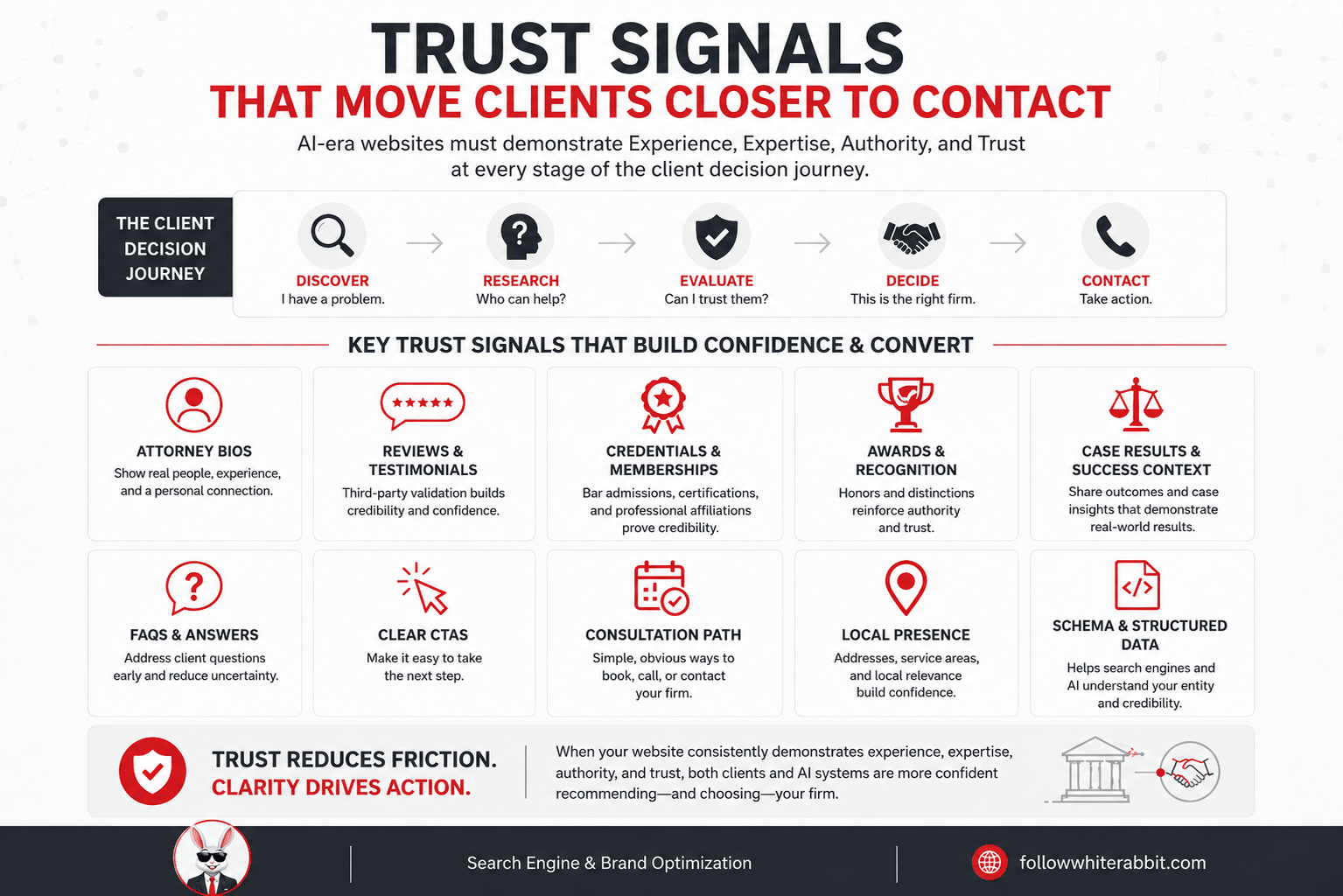
Trust signals help clients evaluate credibility and move closer to contacting a law firm.
A law firm website built for the AI era should be able to answer yes to questions like these:
Technical and Structural
- Is the site fast, secure, mobile-friendly, and crawlable?
- Are important pages easy to find from the navigation?
- Are URLs clean and descriptive?
- Are pages properly indexed?
- Are internal links helping users and search engines understand the site?
- Are images optimized without slowing down the experience?
Entity and Trust
- Is the firm clearly identified?
- Are attorney names, bios, headshots, and credentials easy to find?
- Are practice areas connected to the attorneys who handle them?
- Are office locations clear and consistent?
- Are reviews, awards, memberships, or other trust signals used appropriately?
- Are external professional profiles consistent with the website?
Content and Authority
- Do practice-area pages answer real client questions?
- Does the site explain the process, risks, consequences, and next steps?
- Are FAQ pages used strategically rather than automatically?
- Does the blog support core practice areas?
- Are articles connected to attorney authorship?
- Does the content include real insight instead of generic summaries?
AI Visibility
- Does the site answer natural-language questions clearly?
- Does structured data match visible page content?
- Are entities, services, and locations easy to understand?
- Is the firm’s authority reinforced across third-party sources?
- Can AI systems associate the firm with the right legal topics and geographic markets?
- Does the website support the broader Discovery Stack?
Conversion
- Is it easy to call the firm from mobile?
- Are consultation CTAs visible and clear?
- Does the page flow reduce anxiety and build confidence?
- Are forms simple and functional?
- Does the site make the next step obvious?
- Does the design feel modern, professional, and trustworthy?
This checklist is not about chasing a single algorithm.
It is about building a better law firm website.
A website that helps clients.
A website that search engines can understand.
A website that AI systems can interpret.
A website that supports trust across the entire digital ecosystem.
Frequently Asked Questions About Law Firm Website Optimization in the AI Era
What is law firm website optimization?
Law firm website optimization is the process of improving a law firm’s website to attract the right visitors, explain the firm’s services clearly, build trust, improve search visibility, and convert visitors into consultations. In the AI era, optimization also means making the firm, attorneys, practice areas, locations, and authority signals easier for search engines and AI systems to understand.
How is law firm website optimization different in the AI era?
Law firm website optimization is different in the AI era because search is becoming more conversational, entity-driven, and trust-based. A website still needs technical SEO, strong content, and good design, but it also needs a clear attorney identity, structured information, helpful answers, topical authority, third-party corroboration, and content that reflects real professional insight.
Does SEO still matter for law firms?
Yes, SEO still matters for law firms. AI search does not eliminate the need for crawlable pages, strong content, internal links, technical health, local relevance, and clear site structure. What has changed is that SEO now needs to work with broader authority signals, including attorney credibility, reviews, directories, Google Business Profile, social platforms, public conversations, and AI visibility.
What should a law firm website include for E-E-A-T?
A law firm website should support E-E-A-T by clearly showing experience, expertise, authoritativeness, and trustworthiness. This can include detailed attorney bios, professional headshots, practice-area depth, helpful educational content, reviews, testimonials where allowed, case results where appropriate, bar admissions, professional memberships, media mentions, author pages, and transparent contact information.
Can schema help a law firm website appear in AI search?
Schema can help clarify the meaning of a law firm website, but it should not be treated as a shortcut to AI visibility. Structured data can identify attorneys, articles, FAQs, breadcrumbs, office locations, and organization details when those elements are actually visible on the page. Schema works best when it supports clear, useful, trustworthy content.
Why are attorney bios important for AI visibility?
Attorney bios are important because they help clients, search engines, and AI systems understand who is behind the legal content. A strong attorney bio can connect a lawyer to practice areas, jurisdictions, credentials, professional experience, publications, and trusted external profiles. This helps strengthen the attorney’s entity signals and supports the law firm’s broader authority.
Should law firms use AI to write website content?
Law firms can use AI to assist with content planning, organization, research prompts, outlines, and drafting support, but legal content should still be guided and reviewed by people with real legal and marketing judgment. Generic AI-written legal content can sound polished but thin. The strongest law firm content includes attorney insight, local nuance, practical examples, and a clear point of view.
What makes a law firm website trustworthy?
A trustworthy law firm website is clear, accurate, professional, easy to use, and transparent. It identifies the firm and attorneys, explains services in plain language, provides helpful legal information, shows credible trust signals, makes contact information easy to find, avoids exaggerated claims, and gives visitors confidence that the firm understands their problem.
How often should a law firm update its website?
A law firm should update its website whenever practice areas, attorney information, office details, laws, procedures, FAQs, or client needs change. Beyond occasional updates, firms should regularly review core pages, attorney bios, internal links, schema, technical performance, and content gaps to make sure the site still reflects the firm’s authority and current strategy.
What is the biggest mistake law firms make with their websites?
One of the biggest mistakes law firms make is treating the website as a static brochure instead of an authority engine. A modern law firm website should not simply list services and ask visitors to call. It should answer real questions, build trust, show attorney authority, connect related topics, support local and AI search visibility, and make the next step easy.
Conclusion: The Law Firm Website Has a Bigger Job Now
Law firm websites used to be judged mainly by rankings, traffic, and leads.
Those metrics still matter.
But they are no longer the whole story.
In the AI era, a law firm website must also support entity recognition, attorney authority, topical depth, trust, conversion, and digital consensus.
It has to serve three audiences at once:
- Clients who need help.
- Search engines that need structure.
- AI systems that need clarity and corroboration.
That requires a different kind of website strategy.
Not just design.
Not just SEO.
Not just content.
Not just schema.
Not just conversion optimization.
All of it has to work together.
The law firm website is now the firm’s owned authority engine.
And the firms that understand that shift will be better positioned for the next era of search, AI discovery, and client trust.
Build a Law Firm Website That Works for the AI Era
White Rabbit helps law firms build visibility for the way clients search now — across Google, AI search, reviews, legal directories, Reddit, LinkedIn, and the broader digital ecosystem.
We design and optimize law firm websites to do more than look professional. We build them to clarify authority, strengthen trust, support SEO, improve conversion, and help search engines and AI systems understand why a firm should be recognized.
If your law firm website still feels like a brochure, it may be time to turn it into an authority engine for the AI era. Contact White Rabbit Marketing to start the conversation.
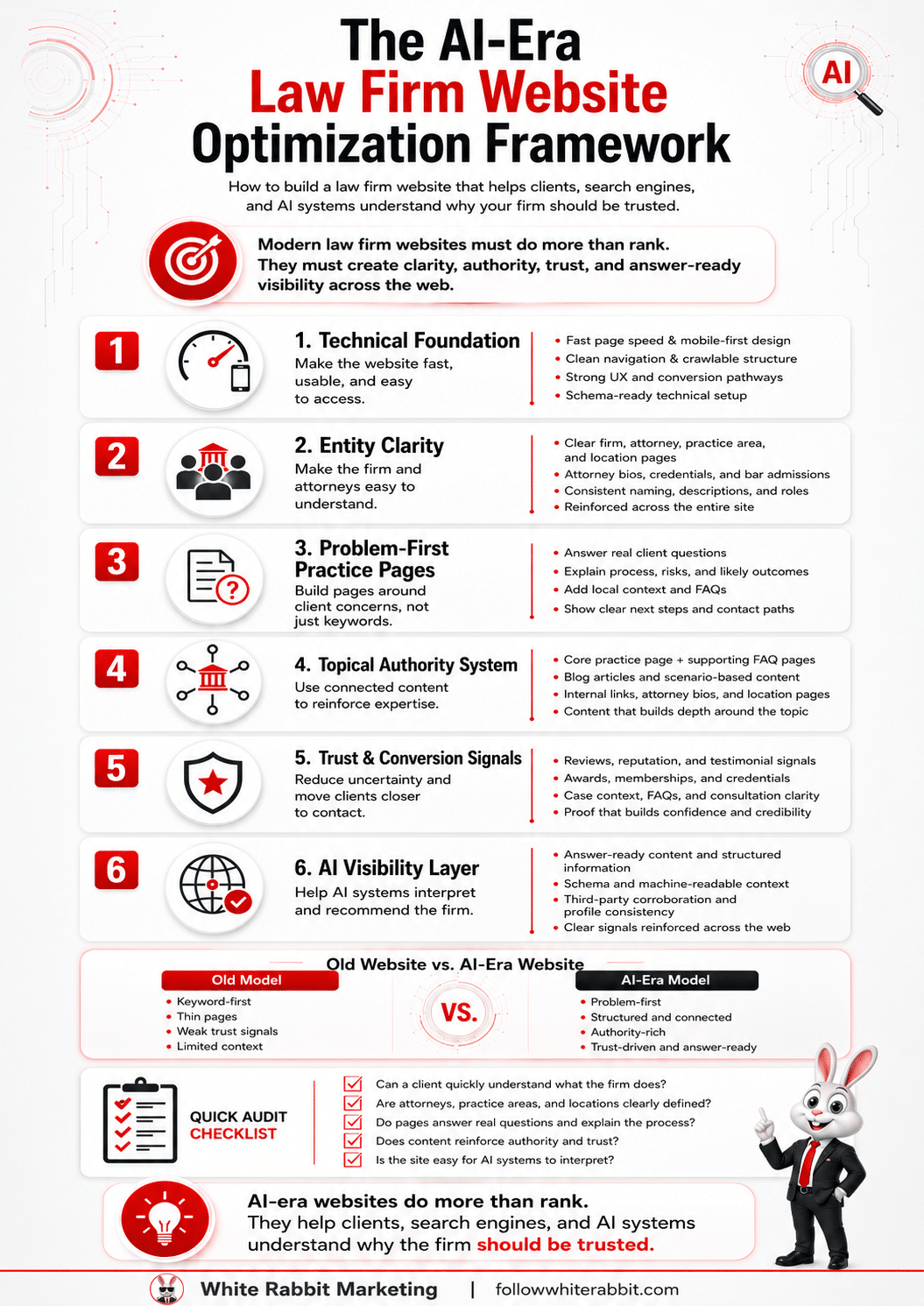
Save or share this framework. If you republish or reference this infographic, please credit White Rabbit Marketing and link to the original article: https://www.followwhiterabbit.com/law-firm-website-optimization-ai-era/

David Faltz
Latest posts by David Faltz (see all)
- How AI Decides Which Lawyers and Law Firms to Recommend - July 15, 2026
- How to Build and Optimize a Law Firm Website for the AI Era - July 3, 2026
- The Discovery Stack™: Why Visibility Now Happens Across More Than Just Google - June 22, 2026