



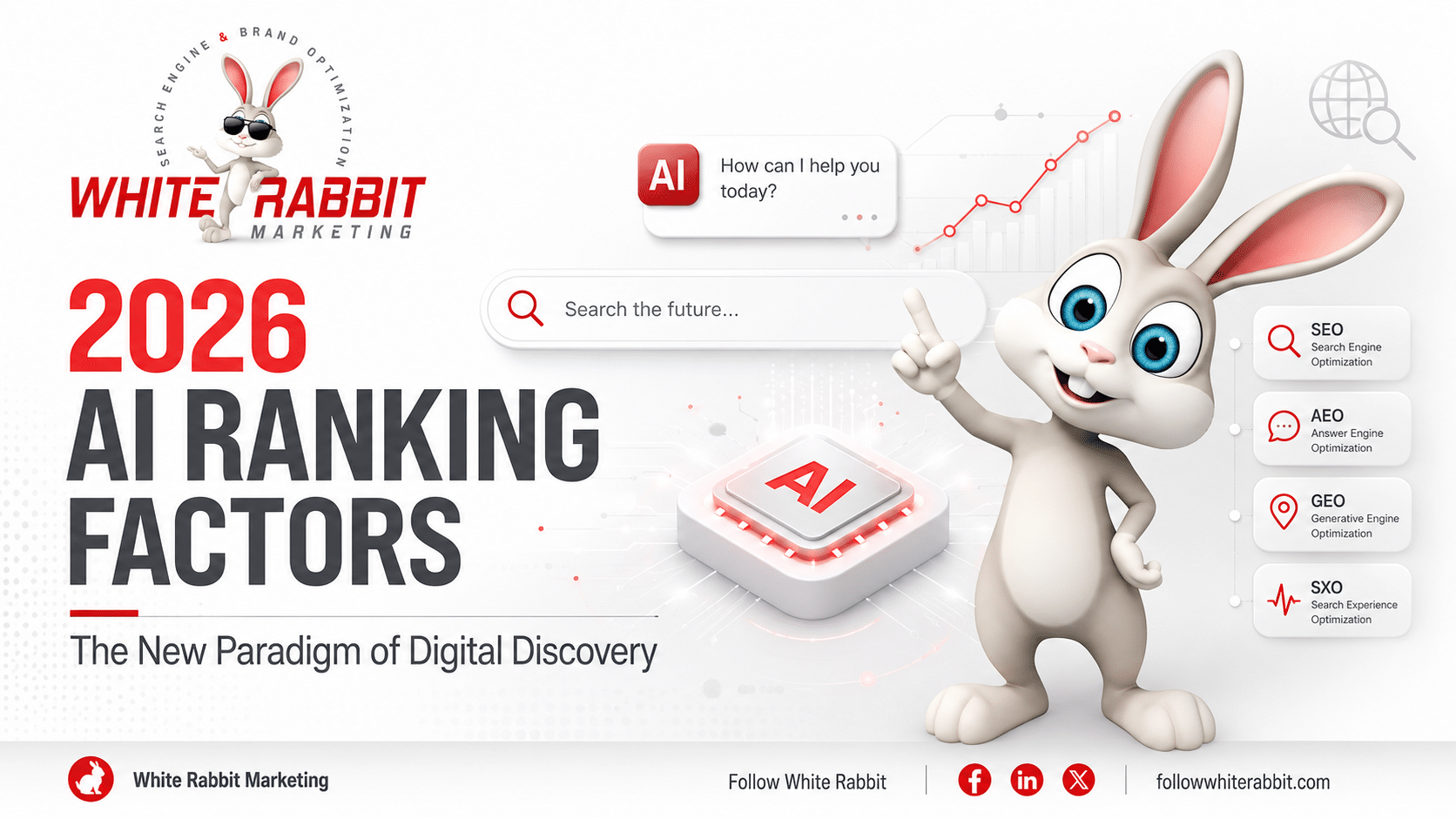
Google search doesn’t look like it used to, and if your business is still relying on a traditional SEO playbook, you are optimizing for a version of the internet that no longer exists. We have officially shifted from a keyword-centric search model to a conversation-mediated environment.
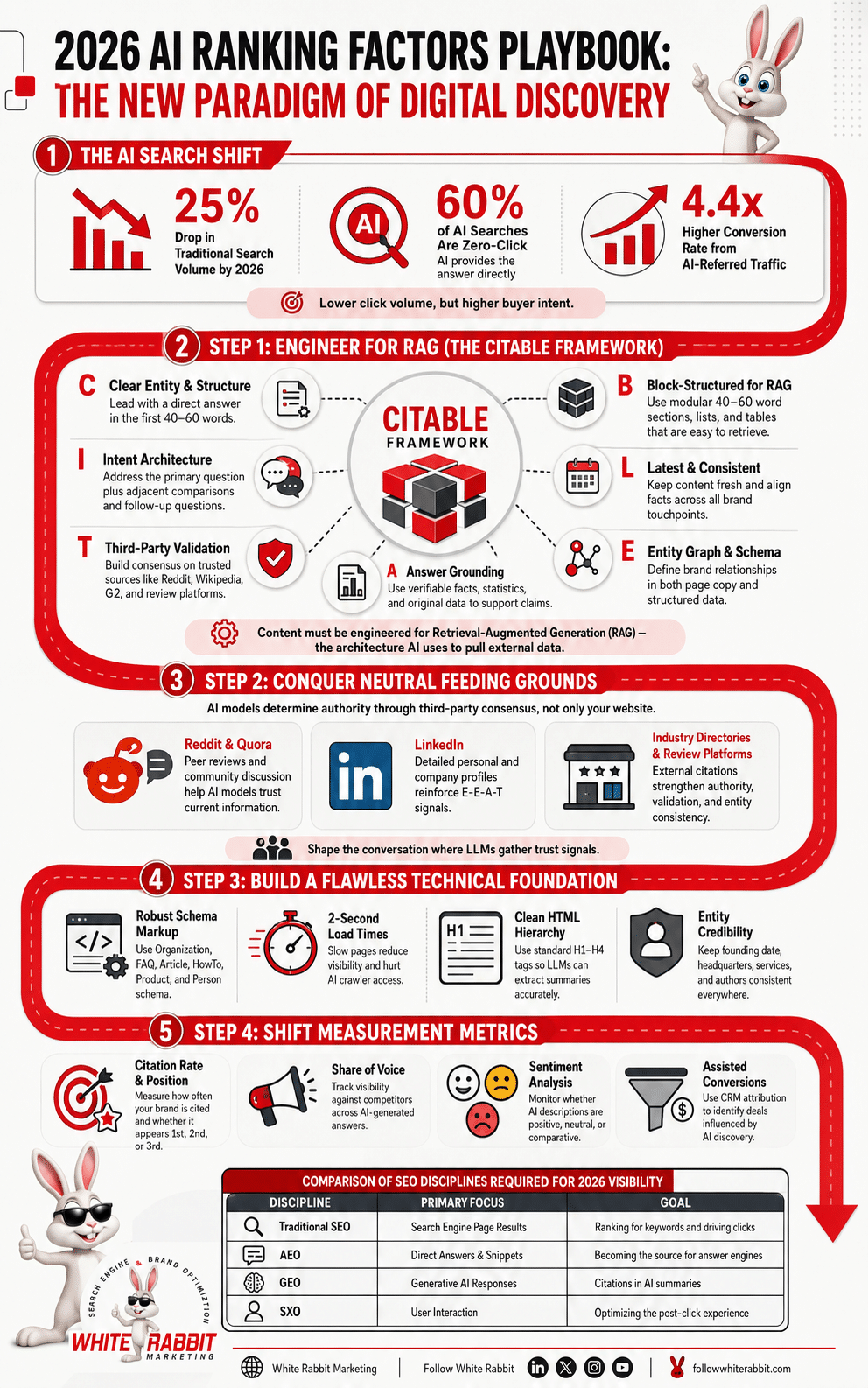
At White Rabbit Marketing, we are seeing this fundamental transformation firsthand. According to Gartner industry data, traditional search volume is projected to decline by 25% by 2026, with organic traffic potentially halving by 2028. Furthermore, roughly 60% of AI searches now end in a “zero-click” resolution, meaning the AI provides the answer directly within the interface without the user ever visiting a website.
This might sound alarming to businesses used to chasing traditional web traffic. However, there is a massive silver lining: AI-referred traffic converts at 4.4x the rate of traditional organic traffic. Buyers who click through from an AI summary are highly qualified and exhibit much shorter sales cycles.
To survive and thrive in this new landscape, businesses must balance four interconnected disciplines: Traditional SEO, Answer Engine Optimization (AEO), Generative Engine Optimization (GEO), and Search Experience Optimization (SXO).
Here is the operational playbook for dominating AI search in 2026.
- Engineer Your Content for “RAG” using the CITABLE Framework
In 2026, content must be engineered for “Retrieval Augmented Generation” (RAG), the actual technical architecture AI uses to pull and synthesize external data. To achieve this, we look at the CITABLE framework to make content highly attractive to Large Language Models (LLMs):
- C – Clear Entity & Structure (BLUF): Stop burying the lead. Utilize a “Bottom Line Up Front” approach by answering the user’s core question directly within the first 40–60 words of your content.
- A – Answer Grounding: Generative engines favor verifiable facts. Adding quantitative data and statistics to your content yields a 40% higher citation rate than qualitative claims.
- B – Block-Structured Formatting: Structure your content in modular, 40-60 word paragraphs that can stand alone. Use comparative tables and ordered lists; in fact, content utilizing tables is cited 2.5x more often by AI systems.
- L – Latest & Consistent: Generative engines hate outdated information. Over 76% of ChatGPT’s most-cited pages were updated within the last 30 days.
The AI-READY Framework
A systematic approach for operationalizing AI SEO:
- A – Audit Technical Eligibility: Ensure pages are crawlable, indexable, and eligible for snippets.
- I – Identify Intent Layers: Map keyword intent to conversational prompts and multi-step questions.
- R – Reinforce Entities: Use clear definitions and schema to connect concepts.
- E – Explain with Evidence: Support claims using expert review, original data, and official documentation.
- A – Answer First: Format sections for easy extraction by AI models.
- D – Develop Topical Authority: Connect pages to broader content clusters.
- Y – Yield Measurable Signals: Track AI-specific visibility metrics.
Pro-Tip: Long-form comprehensive guides (over 2,000 words) signal authority to AI and earn 3x more citations.
- Conquer the Neutral “Feeding Grounds”
AI models determine your authority by looking for “third-party consensus”. They do not rely solely on your own website to verify if your brand is credible.
To win AI citations, you must establish a dominant presence on the high-authority platforms that AI crawls for peer reviews and community vouching. Platforms like Reddit and Quora currently account for a significant share of citations in tools such as Perplexity and Google AI Overviews. Earning visibility on platforms like Reddit, Wikipedia, and G2 makes a brand 2.8x more likely to appear in ChatGPT responses. High-detail LinkedIn profiles are also essential to reinforce your company’s E-E-A-T (Experience, Expertise, Authoritativeness, and Trustworthiness).
- Build a Flawless Technical Foundation
To be cited by AI, your website must be perfectly machine-readable. The technical requirements for 2026 focus heavily on ease of parsing:
- Schema Markup: This is your site’s machine-readable backbone. Essential schema types include Organization, FAQ, Article, How To, and Person (to identify your expert authors).
- Lightning-Fast Page Speed: AI crawlers are impatient. Visibility drops significantly for websites with load times exceeding two seconds.
- Clean HTML: Standardize your H1-H4 heading tags to help LLMs accurately extract content summaries.
- Shift Your Measurement Metrics
Traditional rank tracking simply won’t cut it anymore. Success in the AI era is measured by “Citation Frequency” and “Share of Voice”. You need to track your Citation Rate (the percentage of buyer-intent queries in which your brand appears in an AI response) and your Citation Position (whether you are listed 1st, 2nd, or 3rd in AI recommendation sets).
Follow the White Rabbit to AI Visibility
The rules of digital marketing have changed. But as a small agency delivering big results, White Rabbit Marketing blends personal attention with the massive impact of a major firm, keeping our clients ahead of the curve. We combine creative search engine optimization, web design, and content creation into powerful inbound campaigns that capture user attention.
Don’t let your business disappear behind AI summaries. We can help position your brand as a trusted, AI-optimized authority.
To understand how these AI ranking factors fit into a broader visibility system, see our framework for The Discovery Stack™.
Ready to future-proof your digital pipeline? Call us toll-free at 855-272-8140, locally at 954-368-0870, or email david@followwhiterabbit.com to schedule your consultation today.

David Faltz
Latest posts by David Faltz (see all)
- What Happened to Google’s First Page? How AI Is Reshaping Search in Real Time - September 5, 2026
- How AI Decides Which Lawyers and Law Firms to Recommend - July 15, 2026
- How to Build and Optimize a Law Firm Website for the AI Era - July 3, 2026