



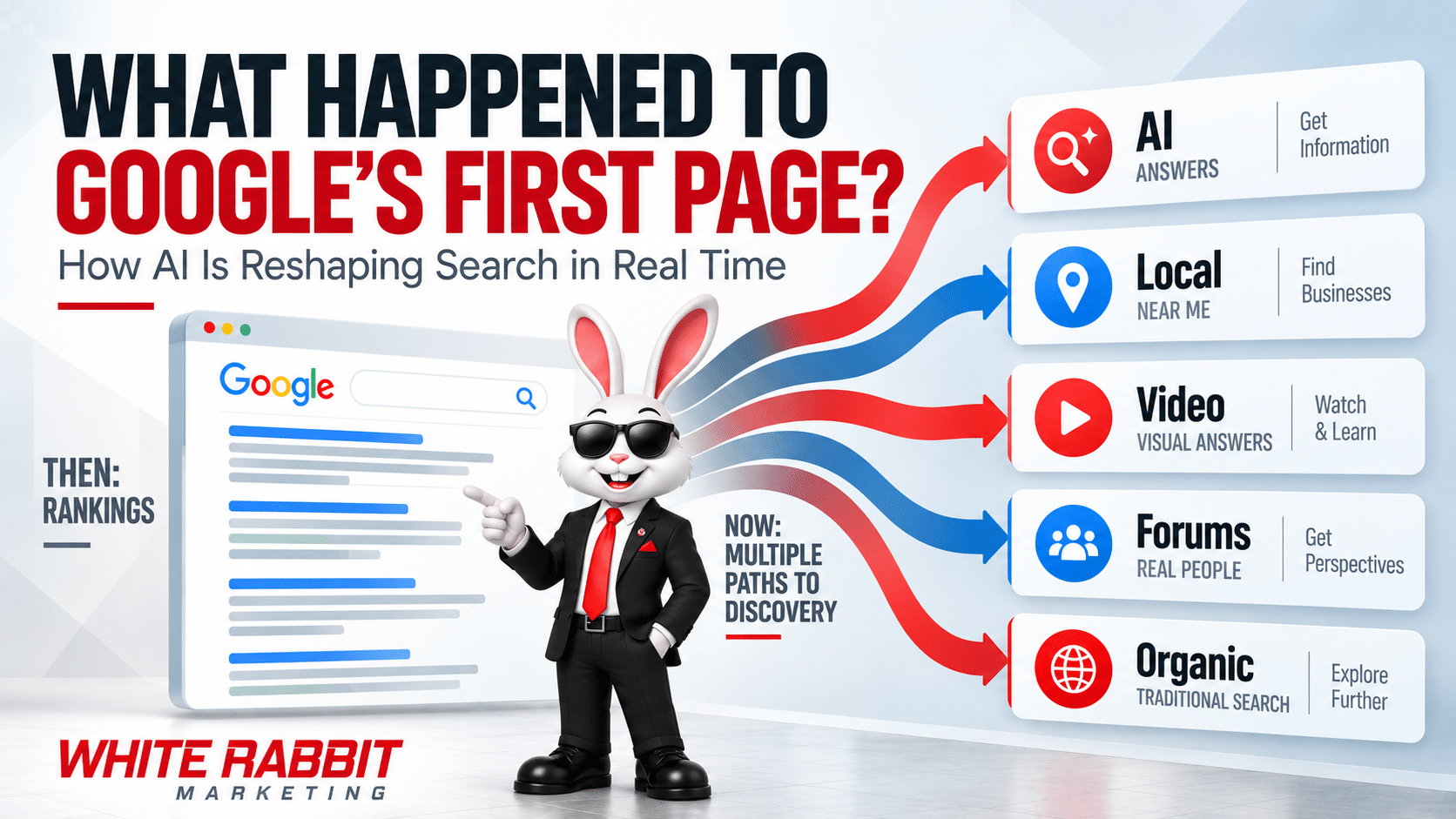
Google’s first page is no longer one simple destination — discovery now happens across multiple surfaces and pathways.
For years, “ranking on page one of Google” was easy enough to understand.
The exact layout changed from search to search, but the basic structure was familiar: ads, perhaps a Local Pack, organic results, and a collection of features such as People Also Ask, featured snippets, videos, images, or shopping results.
Businesses learned how to compete inside that system.
Today, the system itself is changing.
Google Search is becoming less like a static list of ranked pages and more like a dynamic answer-and-discovery environment. AI Overviews, AI Mode, local businesses, traditional organic listings, videos, forums, products, Maps data, citations, and follow-up questions can all become part of the same search journey.
The first page of Google has not disappeared.
But what it means to be visible on it is changing quickly.
The First Page Was Never Really Static
Google has been adding layers to its search results for years.
Featured snippets changed what it meant to rank first. Local Packs created a separate competition for geographically relevant searches. Knowledge Panels, People Also Ask, image results, video carousels, shopping listings, and other SERP features gradually moved Google away from the simple “10 blue links” model.
Generative AI is different because it can do more than preview or organize information.
It can synthesize information into an answer.
Instead of simply displaying a collection of pages and asking the searcher to decide which one to visit, Google can increasingly interpret the question, draw from multiple sources, assemble a response, recommend possible options, and continue the conversation through follow-up questions.
Google is not being subtle about the direction.
At Google I/O 2026, the company described its redesigned AI-powered Search box as the biggest upgrade to Search in more than 25 years. Google says AI Mode has surpassed 1 billion monthly active users, while AI Overviews now reach more than 2.5 billion monthly active users. Google’s Search announcements at I/O 2026 make clear that AI is becoming central to how the company is rethinking Search.
This is no longer an experimental feature sitting beside traditional search.
AI is becoming part of the Search experience itself.
AI Is Becoming the Search Experience
One of the clearest signs is the increasingly seamless relationship between AI Overviews and AI Mode.
Google has been designing Search so a user can begin with a normal query, receive an AI-generated overview, and then continue with conversational follow-up questions without starting over. At I/O 2026, Google described this as a unified AI Search experience in which users can move from a query to an AI Overview and then into AI Mode. Google’s I/O 2026 announcements outline that broader shift.
User behavior is changing along with the interface.
Google reports that AI Mode queries have more than doubled every quarter since launch and that overall Search queries recently reached an all-time high. The company says people using these AI features aren’t simply searching more; they are asking more complex, conversational questions. Google’s AI Mode usage insights provide more detail on how search behavior is evolving.
That makes the traditional idea of a single “search result” harder to define.
A search journey might now look more like:
Question → AI-generated answer → follow-up → business recommendation → supporting sources → Maps → website
rather than:
Search → ranking result → website
That is a fundamentally different discovery path.
Ranking #1 Does Not Necessarily Mean Being Seen First
This is one of the most important practical changes for marketers and business owners.
A webpage can technically hold the top traditional organic position while appearing well below what the user encounters first.
Depending on the search, Google may surface:
- advertisements
- an AI Overview
- local businesses
- product listings
- video results
- People Also Ask
- forum or discussion content
- images
- other specialized SERP features
before the first conventional organic listing.
That creates an increasingly important distinction between ranking position and actual visibility.
They are not always the same thing.
A business may rank extremely well and still receive less attention if Google answers much of the user’s question before the organic listing is reached.
The opposite can also happen.
A brand can gain exposure because Google cites it, mentions it, recommends it, or uses information associated with it inside an AI-generated experience — even when that company’s website does not hold the first traditional organic position.
That creates both new risks and new opportunities.
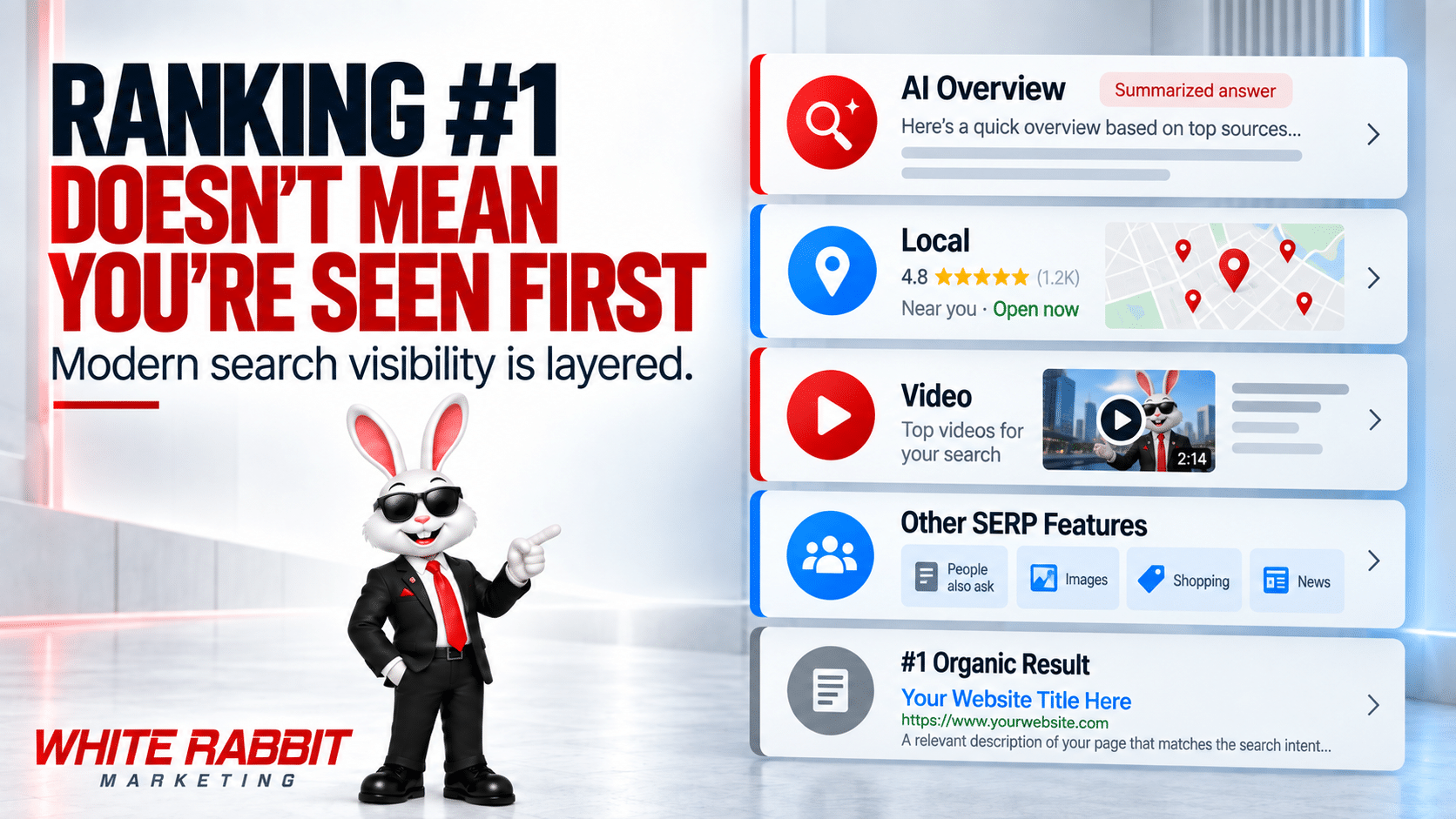
Google’s first page is no longer just about the top organic listing—other features often take the most visible space first.
AI Is Moving Deeper Into Commercial Search
Early discussion about AI Overviews focused heavily on informational searches.
That made sense.
Questions such as “What is this?” or “How does this work?” were obvious candidates for an AI-generated summary.
But AI is increasingly appearing during commercial research as well.
A 2026 Semrush analysis examined more than 600,000 keywords across 10 industries. During its six-month study period, the share of commercial-intent SERPs containing AI Overviews increased by an average of 71%. Semrush also found that Google Ads and AI Overviews were appearing on the same SERP roughly twice as often as they had a year earlier. Read the Semrush AI Overviews commercial search study.
The distinction between commercial and transactional searches matters.
Someone conducting a commercial search is often evaluating choices rather than making an immediate purchase.
They may be asking:
- Which provider should I choose?
- What company is best for this?
- Which service fits my situation?
- What are the differences between these options?
- Who can I trust?
Those are exactly the types of searches where being part of the evaluation process matters.
AI’s expansion into commercial searches therefore changes the business implications considerably.
This is no longer only a publishing problem involving informational articles and reduced blog traffic.
AI is moving closer to where customers compare companies, services, professionals, and products.
The Effect on Clicks Is Becoming Harder to Ignore
Growing evidence also suggests that AI-generated answers affect whether searchers visit websites.
Pew Research Center analyzed real browsing activity from U.S. adults and found that users clicked a traditional search result during approximately 8% of Google visits in which an AI summary appeared, compared with 15% of visits without an AI summary.
Clicks on sources directly cited within the AI summary occurred during only about 1% of visits containing one. Pew Research Center’s analysis of Google AI summaries and click behavior provides the underlying data.
Ahrefs has found a similar pattern from another perspective.
Its 2026 analysis used a dataset of 300,000 keywords and found that the presence of an AI Overview correlated with a 58% lower average click-through rate for the top-ranking page compared with its modeled counterfactual. Read the updated Ahrefs AI Overview click-through-rate study.
That statistic needs context.
It does not mean every website showing beneath an AI Overview will lose 58% of its traffic.
The Ahrefs research is observational, and search behavior differs considerably by query.
But the larger implication is increasingly difficult to dismiss:
Holding a high organic ranking does not necessarily produce the same number of clicks it once did.
Visibility and website traffic are becoming less tightly coupled.
Local Search Is Changing Too
Local may be one of the most important areas to watch next.
For years, many local search results could reasonably be described with a familiar hierarchy:
Ads → Local Pack → organic results
That experience still exists.
But it would be a mistake to assume every locally oriented search will continue to follow that structure.
Local information can now surface through several Google experiences, including traditional Local Packs, Maps, AI-generated recommendations, AI Overviews, AI Mode, business carousels, and increasingly conversational Maps experiences.
Google introduced Ask Maps in March 2026, allowing people to ask complex questions about nearby places and receive personalized recommendations rather than simply entering a category and browsing a conventional list of businesses. Google says Ask Maps can draw on information about more than 300 million places, including community reviews. Google’s Ask Maps announcement explains how that conversational local-discovery experience works.
That is an important evolution.
A search for:
“Italian restaurant near me”
is fundamentally different from:
“Where can I take six people for Italian food tonight that has outdoor seating, is quiet enough to talk and has good vegetarian options?”
The second query requires much more than proximity and category matching.
It requires interpretation.
And that is exactly where AI changes local discovery.
So, Is the Local Pack Disappearing?
Not exactly — and this is where we should resist turning an emerging trend into a sweeping declaration.
There is not sufficient evidence to say Google has universally removed the Local Pack from all search results.
Search layouts vary based on query, intent, device, geography, testing, and other factors.
What is more defensible is this:
Local visibility is becoming less dependent on one predictable SERP module.
BrightLocal’s analysis following Google I/O 2026 similarly cautioned against assuming an immediate disappearance of the traditional Local Pack. At the same time, local-search experts noted that AI Overviews and new SERP layouts can further segment the page, push traditional local and organic results downward, and increasingly recommend specific businesses directly.
That distinction matters.
The traditional Local Pack may remain important while no longer representing the entirety of local search visibility.
A business may increasingly be discovered through:
- Maps ranking
- AI recommendation
- Local Pack inclusion
- review sentiment
- AI Overview citation
- Ask Maps
- traditional organic ranking
or some combination of them.
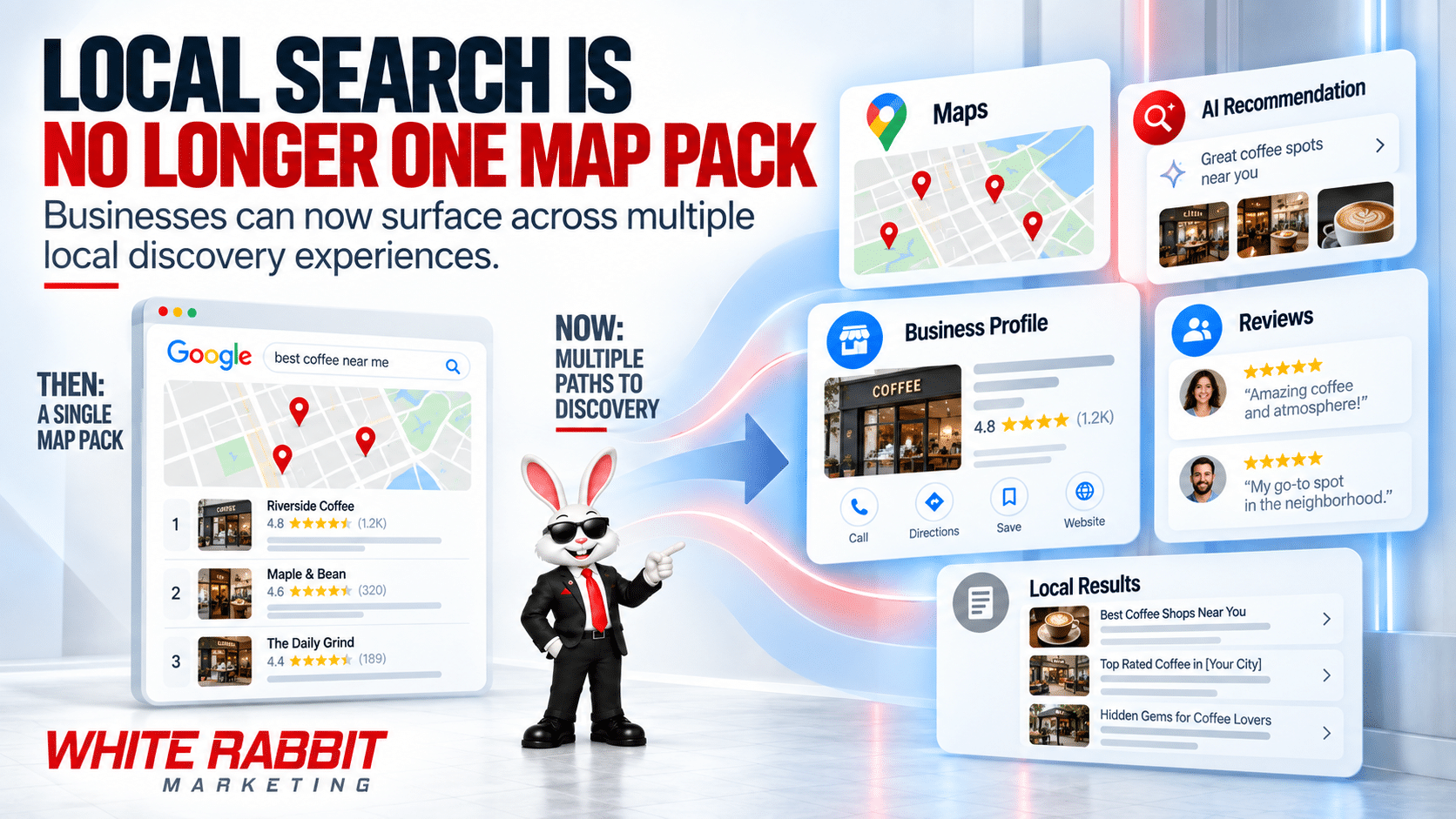
Local visibility is no longer limited to one map pack. Businesses can now surface across multiple search and AI-driven discovery experiences.
For businesses that have spent years watching a single map position, that is a major change in perspective.
Google Is Moving From Listings Toward Recommendations
A larger shift is happening underneath all of this.
Traditional search was primarily a ranking problem.
Google had to answer:
Which pages should appear first?
AI introduces another question:
Which sources, businesses, products, or answers best fit what this person is actually asking?
Those problems overlap, but they are not identical.
Ranking organizes results.
Recommendation requires greater interpretation.
For a business, that may mean Google needs to understand things such as:
- what the company actually does
- what services or products it specializes in
- where it operates
- who is associated with the business
- whether customers have positive experiences
- what reviewers repeatedly say about it
- whether other sources corroborate its claims
- whether its information is consistent across the web
- whether it appears appropriate for the specific searcher’s situation
This is one reason brand clarity and digital authority increasingly matter alongside traditional SEO.
We recently explored this issue specifically for legal marketing in How AI Decides Which Lawyers and Law Firms to Recommend, where the shift from simple rankings toward credibility, relevance, corroboration, and recommendation becomes especially important.
A business cannot simply rank.
Google increasingly has to understand what it is ranking — and sometimes whether that entity deserves to be recommended at all.
The First Page Is Becoming an Answer Layer
A useful way to think about modern Google Search is as an answer layer sitting on top of the web.
Google still crawls websites.
It still indexes pages.
It still ranks organic results.
It still depends on publishers, businesses, product feeds, reviews, forums, videos, Maps information, and countless other web sources.
But increasingly, Google can use those sources to construct part of the search experience before the user visits any of them.
Google’s own actions toward publishers make this clear.
In June 2026, the company introduced additional controls, performance insights, and guidance specifically intended to help website owners navigate generative AI in Search. Google acknowledged that users are increasingly turning to generative AI to find, sort through, and understand information. Google’s guidance and new controls for website owners reflect that changing environment.
That does not mean websites are becoming irrelevant.
It means their role is expanding.
A website can now potentially function as:
- a destination
- an information source
- a citation
- an entity reference
- an authority signal
- a verification source
- part of a synthesized answer
Sometimes several of those at once.
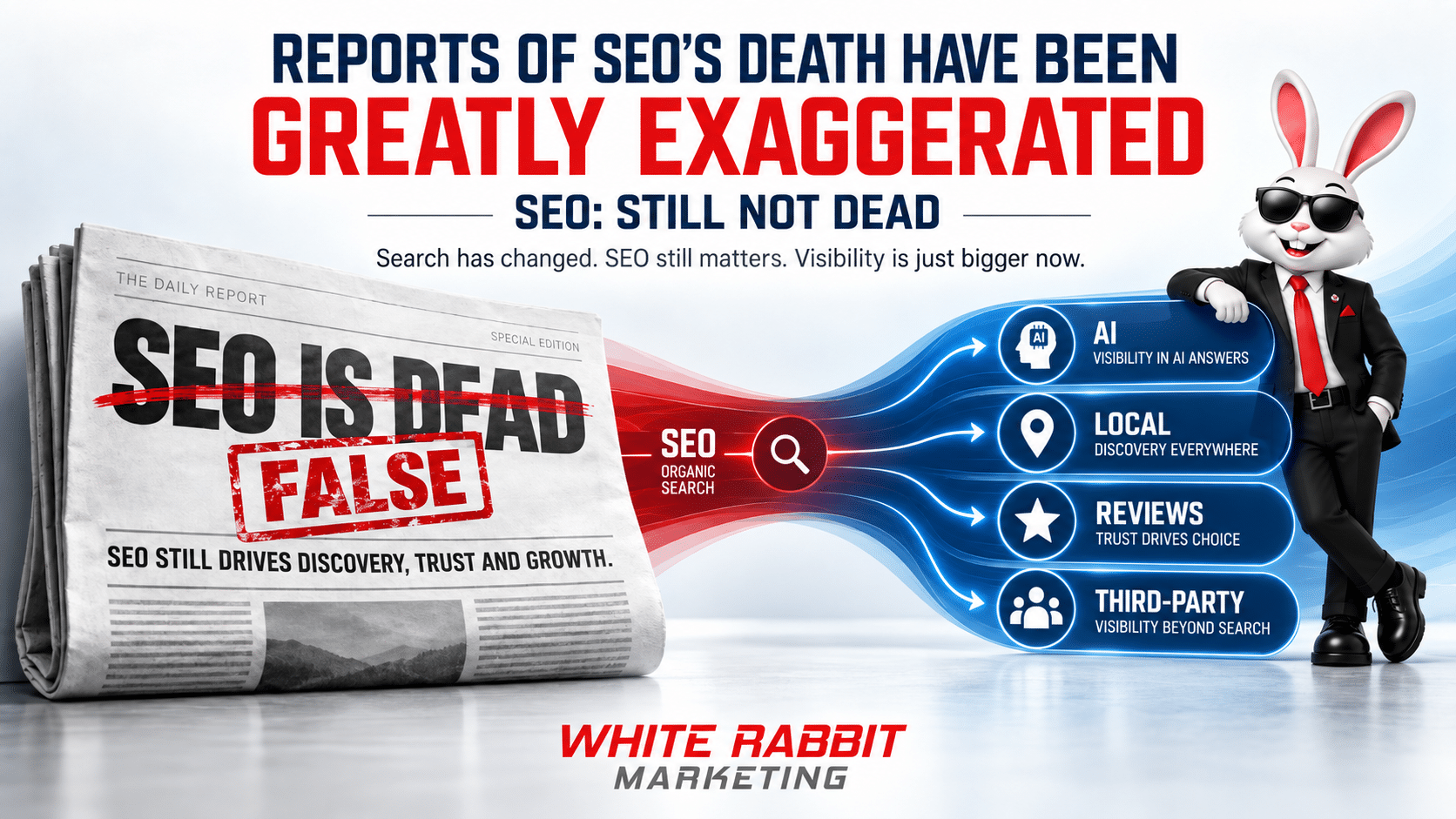
SEO is not dead. Its role has expanded as search visibility now extends into AI answers, local discovery, reviews, and third-party trust signals.
As We Have Said Before, SEO Is Not Dead
We have made this point in previous White Rabbit discussions about AI search, and it remains true:
SEO is not dead.
What is changing is the environment around it.
Google still needs high-quality, crawlable, understandable information.
Local businesses still need accurate business information.
Brands still need authoritative websites.
Content still needs to answer real customer questions.
Technical accessibility, relevance, reputation, authority, internal structure, and good user experiences still matter.
In fact, Google’s own guidance for website owners navigating AI Search continues to reinforce many of those fundamentals.
What is changing is the definition of visibility.
Search performance can no longer be understood only through:
- keyword rankings
- organic sessions
- Local Pack positions
Those remain useful metrics.
But marketers increasingly also need to understand:
- whether a brand appears in AI Overviews
- whether AI systems cite it
- whether it is recommended for relevant questions
- whether Google understands its services and locations
- whether reviews reinforce the desired reputation
- whether third-party sources corroborate its expertise
- whether videos, forums, communities, and other sources influence discovery
- whether branded demand is increasing
- whether customers are encountering the brand before they ever reach its website
The fundamentals of SEO remain.
The competitive field around them is getting much larger.
Stop Asking Only, “Where Do We Rank?”
For years, one of the first questions businesses asked their marketing agency was:
Where do we rank?
It is still a valid question.
It just is not the only one anymore.
A better question for today’s search environment is:
Where does our brand appear when Google tries to answer the customer’s question?
Does Google understand the company?
Does it appear organically?
Does it appear in Maps?
Is it included in an AI-generated response?
Does Google encounter consistent information about the brand across the web?
Do credible third-party sources reinforce what the company claims about itself?
Does the searcher encounter that business somewhere during the decision journey — even if they never scroll to its traditional organic listing?
Those questions better reflect what Search is becoming.
The first page of Google is not disappearing.
It is becoming more dynamic, more conversational, more fragmented, and increasingly influenced by AI.
And as that happens, businesses need to think beyond rankings alone.
They need to understand their visibility across the entire discovery environment.
That is one reason we developed The Discovery Stack™—White Rabbit Marketing’s framework for understanding how brands are discovered, interpreted, reinforced, and trusted across search engines, AI platforms, local results, third-party sources, and the broader web.

David Faltz
Latest posts by David Faltz (see all)
- What Happened to Google’s First Page? How AI Is Reshaping Search in Real Time - September 5, 2026
- How AI Decides Which Lawyers and Law Firms to Recommend - July 15, 2026
- How to Build and Optimize a Law Firm Website for the AI Era - July 3, 2026