




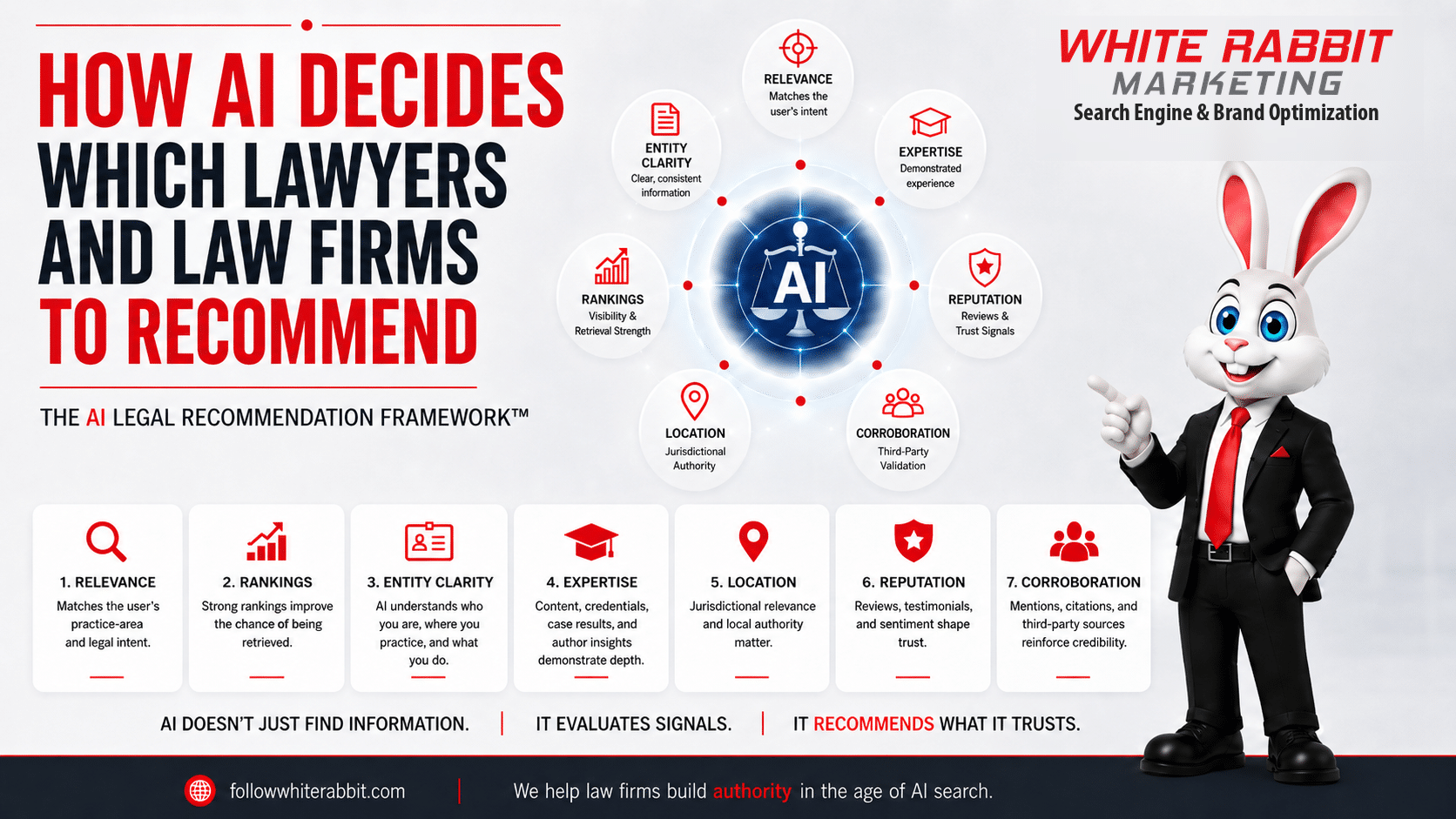
AI does not simply find legal information. It evaluates multiple trust, authority, relevance, and reputation signals before recommending a lawyer or law firm.
A prospective client once began the search for a lawyer by opening Google, reviewing several law firm websites, reading online reviews, and scheduling consultations.
That process still happens.
Increasingly, however, the first question may be asked somewhere else:
- “Who is a good DUI lawyer in Denver?”
- “Recommend an experienced federal criminal defense attorney in Houston.”
- “How do I find a trustworthy personal injury lawyer near me?”
- “Which law firms handle domestic violence cases in Greensboro?”
- “What should I look for when hiring a criminal defense attorney?”
People are asking these questions through ChatGPT, Google AI Overviews, Google AI Mode, Gemini, Perplexity, Copilot, and other AI-powered discovery tools.
The response may include legal information, factors to consider, links to sources, or direct mentions of lawyers and law firms.
That raises an important question:
Why does an AI system mention or recommend one lawyer while overlooking another?
There is no universal formula. The companies developing these systems do not publish a simple list of recommendation factors, and different platforms use different models, search indexes, retrieval methods, source-selection systems, and presentation formats.
However, a growing body of industry research and academic analysis is beginning to reveal patterns.
Traditional rankings still matter. So do website quality, topical relevance, attorney expertise, location, reviews, professional profiles, third-party recognition, technical accessibility, and the consistency of information found across the web.
AI recommendations do not appear to come from one signal.
They emerge from a network of signals that help an AI system answer several questions:
- Is this lawyer relevant to what the user is asking?
- Does the lawyer practice in the correct location and jurisdiction?
- Is there meaningful evidence of experience with the issue?
- Can independent sources corroborate the lawyer’s identity and reputation?
- Is the information current, accessible, and consistent?
- Does the broader web appear to recognize and trust this lawyer or firm?
At White Rabbit, we think about this process through the AI Legal Recommendation Framework™.
The framework does not pretend to reverse-engineer a secret algorithm. It provides a practical way for law firms to understand the signals that may influence whether they are discovered, understood, cited, mentioned, or recommended in AI-generated answers.
AI Recommendations Are Not the Same as Traditional Search Rankings
Traditional search engines generally present users with a ranked list of pages.
AI search systems can do something different. They may retrieve information from multiple sources, compare or synthesize that information, generate a direct response, and decide which sources, businesses, or professionals to mention.
That changes the nature of visibility.
In traditional search, the central question is:
Which page should rank highest for this query?
In AI-assisted discovery, the question becomes broader:
Which lawyer, firm, or source appears relevant, credible, geographically appropriate, and sufficiently supported to include in the answer?
Rankings remain important because they help establish visibility and retrievability. A page that performs well in traditional search may be more likely to enter the pool of sources an AI system evaluates.
But entering that pool is not the same as being selected.
An AI system may also need to determine whether:
- The information precisely answers the question
- The attorney’s identity is clear
- The firm is connected to the correct jurisdiction
- Independent sources support the firm’s claims
- The content contains information that can be confidently extracted
- The broader digital footprint appears trustworthy and consistent
This is why law firms need to think beyond rankings without abandoning SEO.
SEO remains the foundation. AI visibility adds another layer of discovery and evaluation on top of it.
Strong Rankings Matter—but They Do Not Tell the Whole Story
It would be a mistake to claim that Google rankings no longer matter in AI search.
The available evidence suggests the opposite, particularly within Google’s own AI search experiences.
In July 2025, Ahrefs analyzed 1.9 million citations from one million Google AI Overviews and found that 76.1% of cited pages ranked in Google’s top 10. The three most visible citations had a median organic position of three, while the primary citation had a median position of two. See the original Ahrefs AI Overview citation study.
However, AI search changes quickly.
In March 2026, Ahrefs published an updated analysis covering 863,000 keyword search results and four million AI Overview URLs. In the newer dataset, approximately 38% of URLs cited in AI Overviews also appeared in the first 10 search results for the original query. See the updated Ahrefs study.
The change from 76% to approximately 38% does not mean rankings suddenly stopped mattering. Ahrefs attributed at least part of the change to Google’s increasing use of query fan-out, in which an original question is expanded into related subqueries that may retrieve sources beyond the direct search results.
The precise percentage varies according to the dataset, methodology, time period, query set, and AI product being studied. That limitation matters.
Still, the broader lesson is clear:
A law firm that ranks well organically generally begins from a stronger position than one that is difficult to find, poorly indexed, or nearly invisible in traditional search.
Strong rankings increase discoverability. They may also reflect underlying qualities that AI retrieval systems value, including:
- Topical relevance
- Quality backlinks
- Content depth
- Strong internal linking
- Technical accessibility
- Local authority
- Brand recognition
- Content freshness
But rankings do not guarantee selection.
A 2026 academic study involving 55,393 queries across 19 categories found that nearly 30% of pages cited by Google AI Overviews did not appear among the co-displayed first-page results. The researchers concluded that AI Overview source selection appears related to, but distinct from, Google’s traditional ranking process. Read the original study, Measuring Google AI Overviews.
A highly ranked page may earn consideration, but an AI system could still choose another source that provides:
- A more precise answer
- Better jurisdictional context
- Clearer evidence
- Stronger independent corroboration
- More extractable facts
- Better alignment with the user’s wording
- A more neutral or authoritative perspective
The correct conclusion is not that rankings have become irrelevant.
It is that rankings are an important part of a larger recommendation environment.
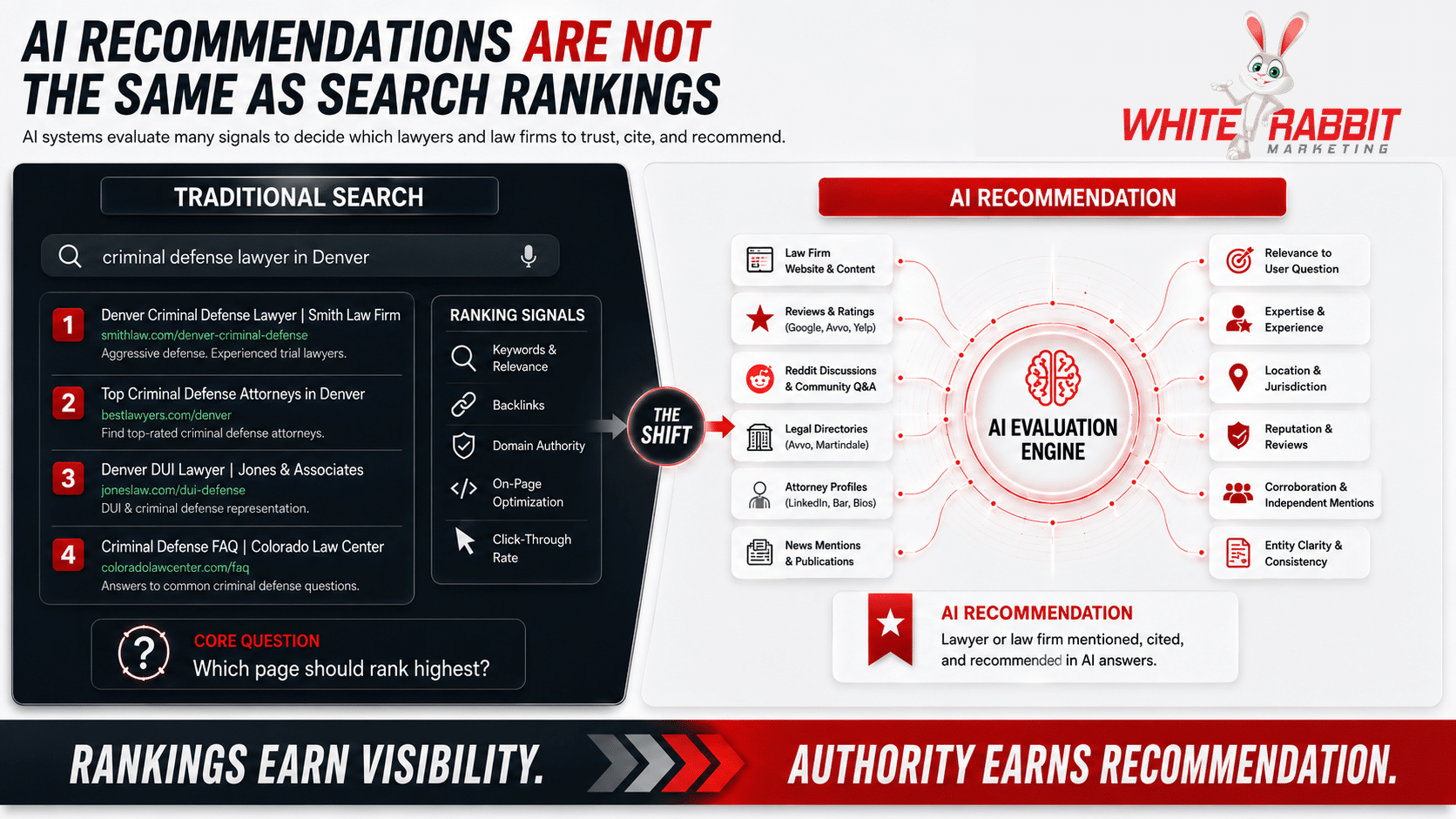
Traditional search asks which page should rank highest. AI recommendation evaluates which lawyer or law firm appears most relevant, credible, authoritative, and sufficiently supported.
Different AI Platforms May Reach Different Conclusions
A page that performs well in Google does not automatically receive the same visibility in ChatGPT, Gemini, Copilot, or Perplexity.
Ahrefs studied AI citations across several platforms and found that only 12% of AI-cited URLs also ranked in Google’s top 10 for the original prompt. The overlap varied by platform, with Perplexity showing considerably more alignment with Google’s results than some other AI assistants. See the Ahrefs cross-platform citation study.
Academic research has identified similar differences.
A 2026 study comparing Google Search, Google AI Overviews, and Gemini across 11,500 user queries found an average source similarity below 0.2. In other words, the systems frequently retrieved substantially different sources for the same queries.
The study also found that AI Overviews could vary between repeated runs and were sensitive to relatively minor changes in query wording. Read the original study, How Generative AI Disrupts Search.
This helps explain why a law firm may:
- Rank prominently in Google, but rarely appear in ChatGPT
- Receive Perplexity citations, but few Google AI Overview citations
- Be mentioned by name without having its website cited
- Appear for one version of a prompt but disappear when the wording changes
- Surface for informational questions but not recommendation-oriented prompts
Law firms should therefore avoid thinking in terms of a single universal “AI ranking.”
A more useful concept is AI visibility across a portfolio of platforms, prompts, and source environments.
The AI Legal Recommendation Framework™
The AI Legal Recommendation Framework™ identifies eight interconnected areas that may influence whether a lawyer or law firm becomes visible in AI-assisted discovery.
Strength in one area can reinforce another. Contradictions between them can weaken the complete authority picture.
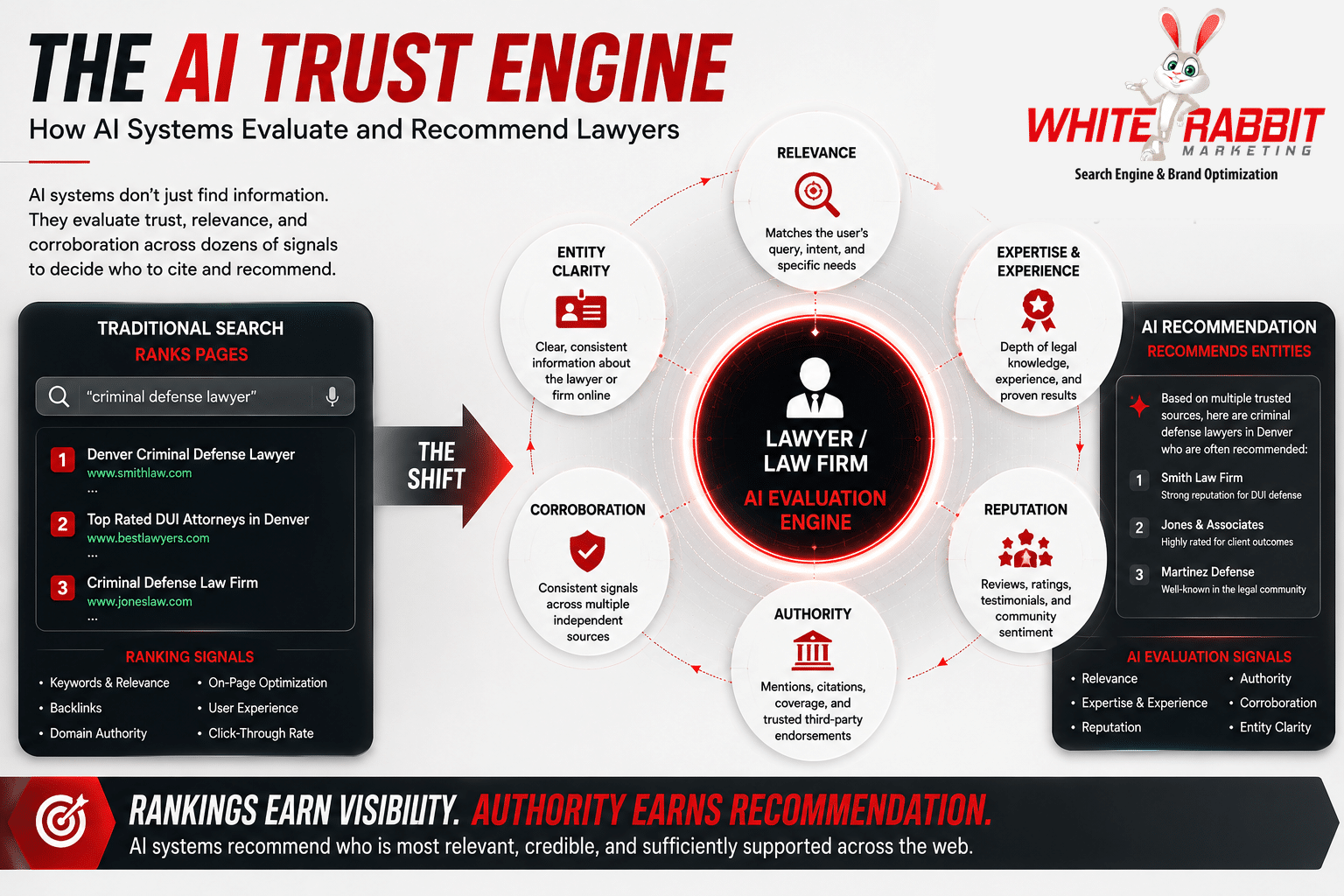
AI systems do not simply rank legal webpages. They evaluate whether a lawyer or law firm appears relevant, experienced, authoritative, reputable, clearly identified, and supported by independent sources.
1. Query and Practice-Area Relevance
Before an AI system can recommend a lawyer, it must determine that the lawyer is relevant to the user’s actual problem.
Consider the difference between:
- Criminal defense lawyer
- DUI lawyer
- Federal criminal defense lawyer
- Federal healthcare fraud lawyer
- Lawyer for a federal target letter
- Attorney for a first-offense DUI involving a breath-test refusal
A law firm may claim to handle criminal cases generally. Another firm may have a much clearer body of content, attorney experience, and independent recognition tied to the specific issue.
Strong relevance signals may include comprehensive practice-area pages, detailed supporting articles, attorney biographies connected to specific areas of practice, FAQs addressing real client questions, process explanations, videos, interviews, and strong internal links.
This does not mean creating hundreds of nearly identical pages.
It means developing a clear and credible body of evidence around the legal matters the firm actually handles.
2. Organic Visibility and Retrieval Strength
Content cannot influence an AI-generated answer if the system cannot find, access, or retrieve it.
Traditional SEO helps make a law firm’s pages discoverable through crawlable architecture, strong titles and headings, descriptive internal links, useful content, quality backlinks, mobile usability, fast performance, accurate indexing, and clear local signals.
Strong organic visibility can increase the likelihood that a law firm will be included in the set of sources considered for an AI response.
But retrievability extends beyond rankings.
A page may be indexed yet remain difficult to use because important information is hidden inside scripts, buried beneath promotional language, presented only in an image, scattered across several pages, blocked from relevant crawlers, or outdated and contradictory.
This is one reason law firm website optimization in the AI era must address both human usability and machine accessibility.
3. Entity Clarity
An AI system needs to understand exactly who the lawyer and law firm are.
A lawyer’s professional identity may be distributed across the firm website, attorney biography pages, state bar records, LinkedIn, Google Business Profile, legal directories, news articles, podcasts, professional organizations, and social profiles.
Ideally, these sources reinforce the same identity.
They should make it clear what the attorney’s full professional name is, which law firm the attorney belongs to, where the attorney practices, which matters the attorney handles, which jurisdictions the attorney is licensed in, and which profiles and content refer to the same person.
Entity clarity does not guarantee an AI recommendation. Without it, however, an AI system may struggle to determine whether multiple references belong to the same lawyer or whether that lawyer is relevant to the request.
4. Demonstrated Expertise
A law firm can claim expertise.
Search engines, AI systems, and prospective clients still need evidence.
Demonstrated expertise may come from detailed attorney-authored articles, practice-area explanations, original legal analysis, videos, webinars, professional presentations, media interviews, published commentary, legal guides, FAQs, and clearly presented credentials.
This is where generic, mass-produced AI content is unlikely to create much lasting differentiation.
Thousands of firms can publish an article titled “What to Do After a DUI Arrest.” Far fewer can offer meaningful insight into what clients frequently misunderstand, which deadlines require immediate attention, how local procedures affect a case, which evidence may become important, and how strategy may vary according to the facts.
The objective is not to reveal confidential information or provide individualized legal advice.
It is to make the attorney’s knowledge visible.
5. Geographic and Jurisdictional Authority
Legal recommendations are unusually sensitive to location.
A lawyer may be highly experienced, but irrelevant to someone searching in a different state or jurisdiction.
An AI system may need to determine where the firm is located, which cities and counties it serves, which state laws apply, which courts and agencies are relevant, where the attorney is admitted to practice, and whether local sources recognize the attorney.
Strong geographic signals may include accurate office information, a well-maintained Google Business Profile, local reviews, state bar profiles, jurisdiction-specific content, local media coverage, court and agency references, community involvement, consistent directory listings, and meaningful service-area content.
Law firms need to connect expertise to geography and jurisdiction through genuine local context, not repetitive city-name insertion.
6. Reputation and Trust
When someone asks an AI system to recommend a lawyer, the system is participating in a trust decision.
Reviews contribute public information about recurring client experiences, including communication, responsiveness, professionalism, honesty, compassion, preparedness, local knowledge, clarity, and follow-through.
Review quantity matters, but quantity alone does not provide the complete picture.
Recency, consistency, specificity, platform diversity, and recurring themes can all help define what a firm is known for.
We should not claim that every AI platform applies a formal review score or sentiment formula when recommending a lawyer. Public evidence does not support that universal conclusion.
However, reviews unquestionably form part of the public information surrounding a firm. They can reinforce or contradict the positioning presented on the firm’s website.
7. Third-Party Corroboration
A law firm’s claim that it is experienced is a first-party claim.
Independent sources supporting that claim create corroboration.
Third-party sources may include state bar directories, legal publications, reputable lawyer directories, news coverage, professional associations, community organizations, podcasts, conference programs, reviews, LinkedIn, Reddit, YouTube, and local business profiles.
Not every mention carries equal weight.
A state bar profile is different from an anonymous Reddit comment. A respected publication is different from a low-quality directory. A legitimate professional organization is different from a purchased badge.
Together, credible external references can establish that the firm’s identity and reputation exist beyond its own marketing.
That is one reason attorney-led Reddit participation and other third-party authority channels can play a supporting role in legal AI visibility.
8. Content Usability and Digital Consensus
A final mention or recommendation may depend on how well the available information fits together.
At White Rabbit, we call this digital consensus.
Digital consensus exists when multiple credible sources consistently reinforce the same conclusions:
- This attorney is a real and identifiable professional
- The attorney belongs to this law firm
- The firm practices in this location
- The attorney handles this type of matter
- The attorney demonstrates knowledge of the issue
- Clients and third parties recognize the firm
- The available information is current and consistent
Digital consensus does not mean unanimous praise.
It means there is enough alignment across the web for an AI system to form a coherent understanding of the firm.
This concept is part of White Rabbit’s broader Discovery Stack™ framework, which explains why modern visibility is shaped across more than a law firm’s website or Google rankings.
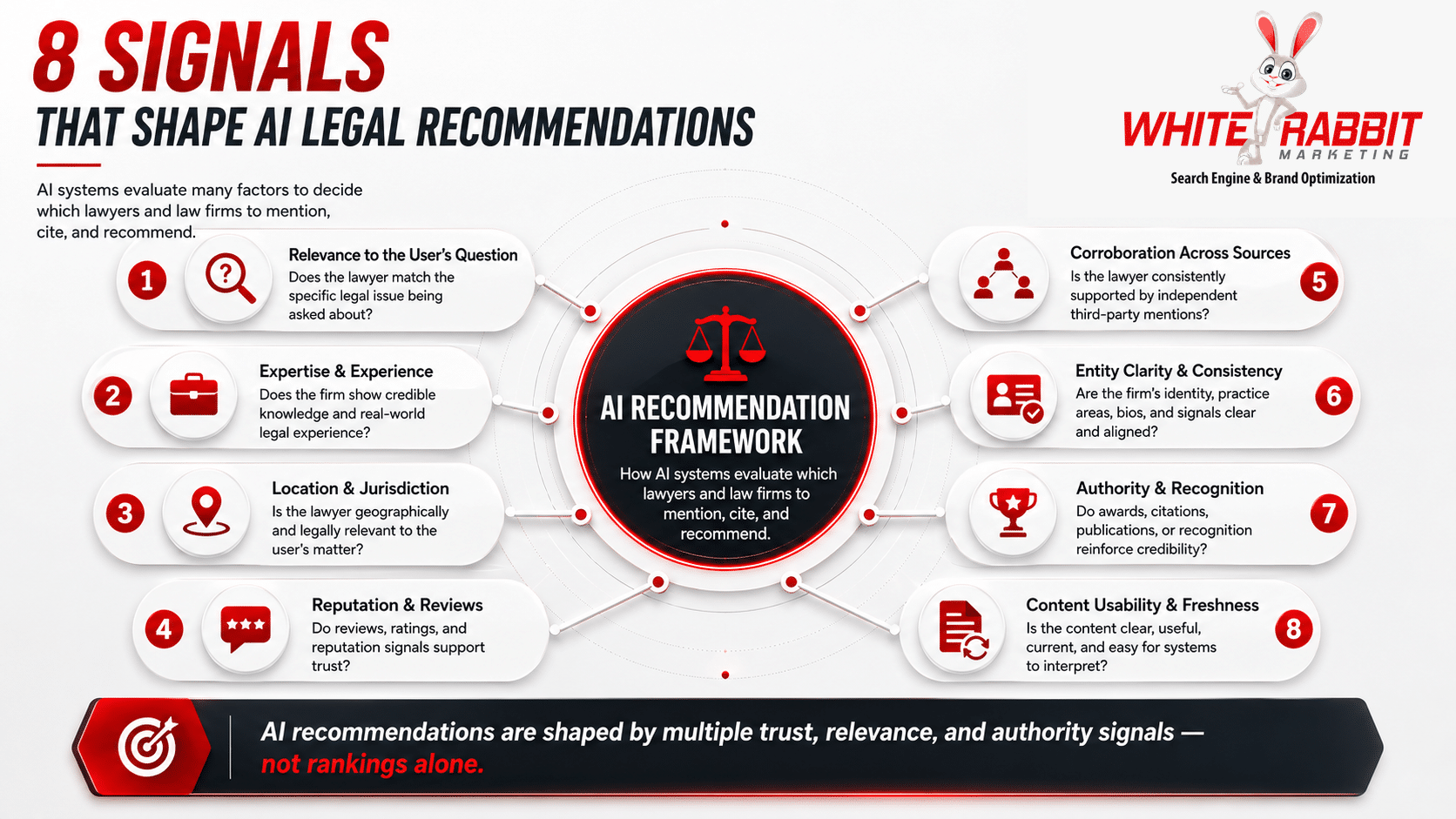
AI recommendations are shaped by multiple trust, relevance, and authority signals—not rankings alone.
Mentions, Citations, and Recommendations Are Different Outcomes
An AI Mention
The system names the lawyer or firm in its response.
An AI Citation
The system links to the firm’s website or another source containing information about the firm.
An AI Recommendation
The system presents the lawyer or firm as a possible choice in response to a recommendation-oriented prompt.
These outcomes can overlap, but they are not identical.
A firm may be mentioned without being cited. An article may be cited without the firm being recommended. A directory or news article may be cited as the source for a recommendation rather than the firm’s website.
The distinction matters because each outcome can indicate something different:
- Mentions may reflect entity recognition.
- Citations may reflect source usefulness.
- Recommendations may require stronger alignment among relevance, location, reputation, and corroboration.
Why Attorney Bios Matter More in AI Search
Attorney biography pages have often been treated as secondary content on websites.
In the AI era, they may be among the most important entities and trust pages on a law firm’s website.
A strong biography helps connect the attorney’s name, law firm, practice areas, location, bar admissions, education, professional experience, authored content, media appearances, awards, memberships, and external profiles.
A thin biography creates ambiguity.
A well-developed biography helps prospective clients, search engines, and AI systems understand who is behind the legal information they are reading.
Attorney biographies should contain specific, verifiable information that supports the attorney’s professional identity. Authorship and identity should also be connected.
An AI system should not have to guess who wrote an article, whether that person is an attorney, or how the author relates to the law firm.
What Law Firms Can Do to Improve Their AI Recommendation Visibility
No law firm can force an AI system to recommend it.
No ethical agency should promise guaranteed ChatGPT recommendations, AI Overview citations, or permanent placement in AI-generated answers.
Firms can, however, improve the quality, clarity, accessibility, and consistency of the evidence available across the web.
Strengthen the SEO Foundation
Continue improving organic rankings, site architecture, internal linking, page performance, mobile usability, crawlability, local SEO, backlinks, and content quality.
AI optimization should build upon SEO, not replace it.
Create Deeper Practice-Area Authority
Develop content that demonstrates what the firm handles and how well its attorneys understand those matters. Focus on substance rather than publishing volume.
Improve Attorney Entity Clarity
Make attorney biographies complete, specific, consistent, and connected to relevant external profiles. Use appropriate structured data to reinforce relationships among attorneys, the firm, locations, and authored content.
Strengthen Local and Jurisdictional Evidence
Create accurate content tied to the courts, laws, agencies, procedures, and client concerns relevant to the firm’s market.
Build Authentic Reviews
Encourage legitimate client feedback while following applicable professional rules. Monitor recurring themes and address reputational issues rather than attempting to conceal them.
Earn Credible Third-Party Recognition
Pursue legitimate media opportunities, professional profiles, speaking engagements, community involvement, and industry contributions.
Make Content Easier to Retrieve
Use clear headings, direct answers, descriptive page titles, concise definitions, useful lists, comparison sections, process explanations, clear authorship, and accessible page structures.
The goal is not to write for machines at the expense of people. It is to make useful human content easier for machines to interpret.
Correct Contradictions Across the Web
Audit firm names, attorney names, addresses, phone numbers, practice areas, professional affiliations, directory profiles, old websites, duplicate listings, and social profiles.
Monitor AI Visibility Directly
Test meaningful prompts across multiple platforms and track whether the firm is mentioned, which competitors appear, which sources are cited, whether the firm is described accurately, and which prompts produce different answers.
What Law Firms Should Not Do
The growth of AI search will inevitably attract shortcuts and manipulation.
Law firms should avoid:
- Fake reviews
- Fabricated awards
- Manufactured Reddit conversations
- Hidden promotional accounts
- Mass-produced AI articles with little attorney involvement
- Hundreds of thin city pages
- Inflated credentials
- Misleading case-result claims
- Duplicate attorney biographies
- Low-quality paid directories
- Keyword stuffing
- Schema describing information not visible on the page
- Claims of guaranteed AI recommendations
AI visibility should not be treated as a technical trick.
It is the result of building a clearer, more credible, and better-supported digital presence.
The Limits of What We Currently Know
AI search is evolving quickly.
A study that accurately describes one platform today may not describe it six months from now.
Results can vary by platform, model, query, location, personalization, data freshness, prompt wording, whether live web retrieval is used, source availability, and platform policy changes.
Research also measures different outcomes. Some studies examine citations. Others measure source overlap, visibility, traffic, mentions, referrals, or answer accuracy.
Those findings should not be treated as interchangeable.
White Rabbit’s position is not that we have discovered a fixed AI recommendation algorithm.
Our position is that the available evidence points toward a broader reality:
AI systems are more likely to understand and surface law firms when strong SEO, clear entities, demonstrated expertise, geographic relevance, credible reputation, technical accessibility, and independent corroboration reinforce one another.
That is not a shortcut.
It is an authority strategy.
AI Recommends the Firms the Web Can Understand and Trust
The future of legal discovery will not be controlled by one platform.
People will continue using Google. They will also ask questions through AI assistants, maps, directories, review platforms, social networks, community forums, and other discovery environments.
Law firms, therefore, need more than rankings.
But they still need rankings.
They need strong websites, but they also need external corroboration.
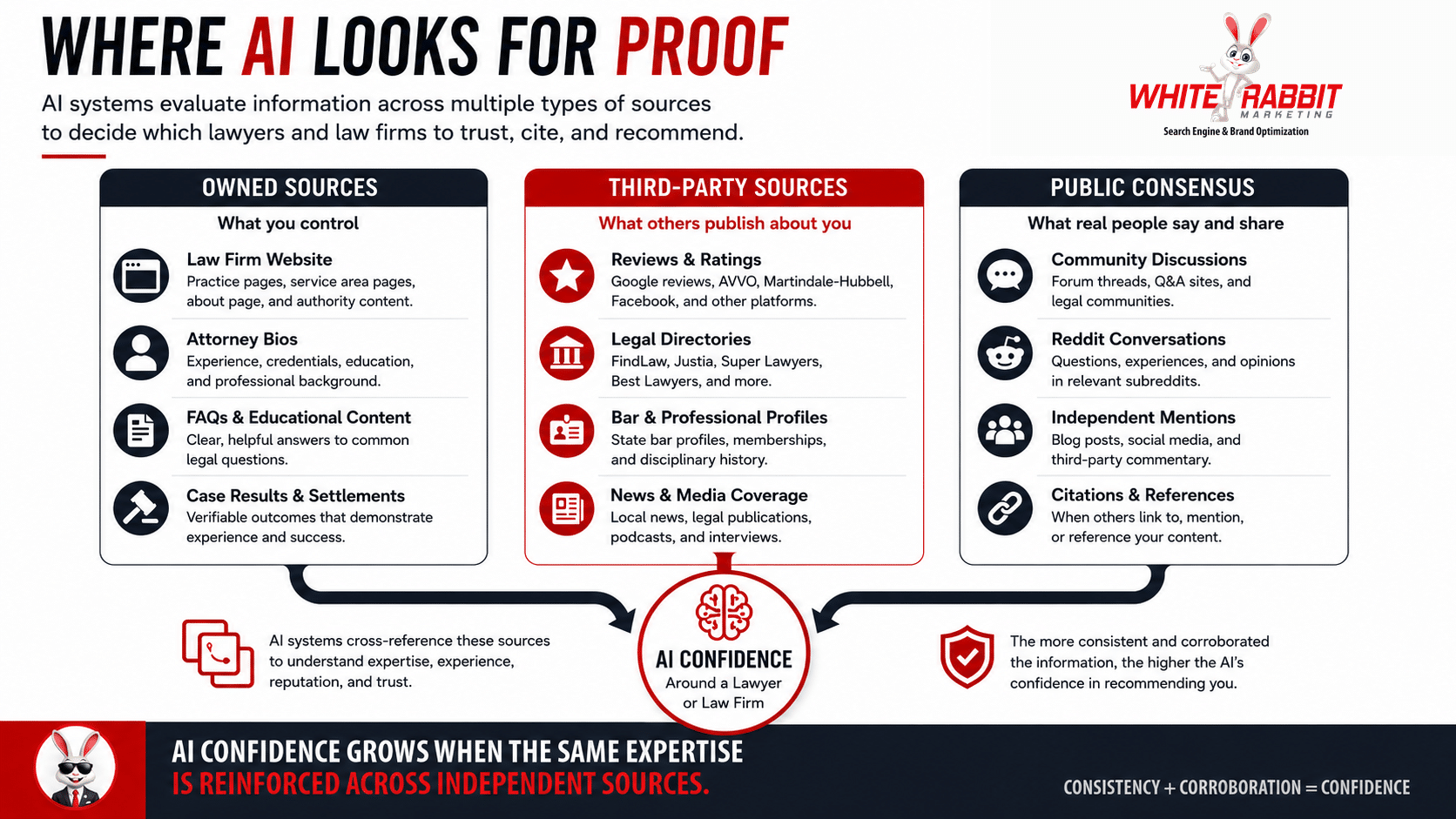
AI confidence grows when the same expertise and reputation are reinforced across independent sources.
They need authoritative content, but they also need clear attorney identities.
They need reviews, local relevance, technical accessibility, and consistency across the web.
Traditional SEO asks:
Can a prospective client find this law firm?
AI-assisted discovery adds another question:
Is there enough credible evidence for a machine to understand why this firm may be relevant and trustworthy?
AI visibility is not achieved by sending a special signal to ChatGPT, Gemini, Perplexity, or Google.
It is earned by creating enough clear, credible, accessible, and consistent evidence that humans, search engines, and AI systems can reach the same conclusion about the firm.
Traditional SEO creates discoverability.
Brand authority creates confidence.
Digital consensus connects the two.
White Rabbit Marketing
White Rabbit Marketing helps law firms build visibility across the full digital discovery ecosystem.
That includes traditional SEO, law firm website optimization, attorney and entity development, content strategy, local visibility, reputation, third-party authority, and AI search monitoring.
We help law firms understand not only whether they rank, but whether prospective clients, search engines, and AI systems can clearly recognize who they are, what they do, where they practice, and why they should be trusted.
The goal is not to chase the latest AI tactic.
It is to build a digital authority system strong enough to remain visible as search continues to change.
The infographic below summarizes the signals AI systems may evaluate when deciding which lawyers and law firms appear credible, relevant, and trustworthy enough to recommend.
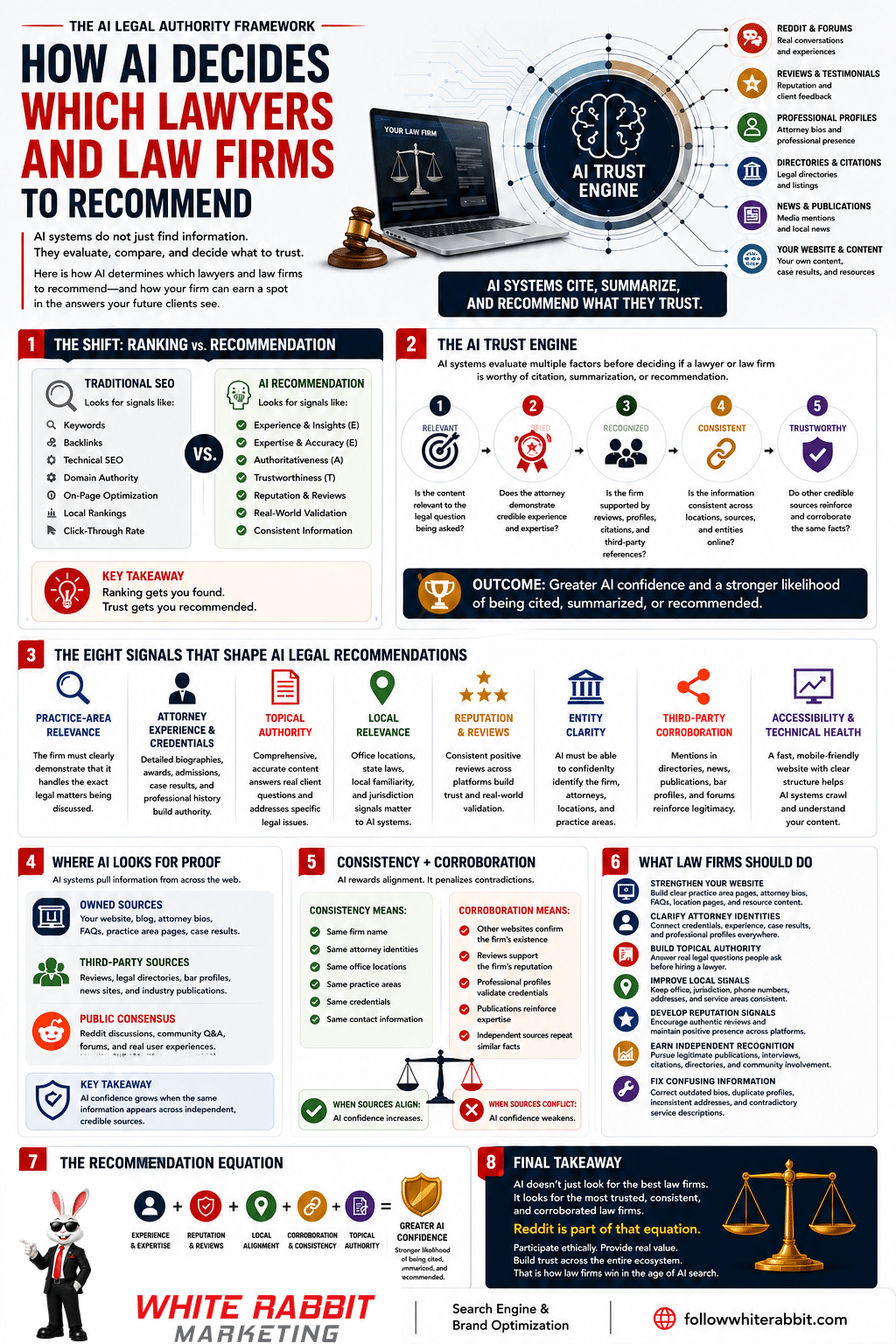
AI recommendations are shaped by more than rankings. They depend on whether a law firm’s expertise, identity, reputation, and relevance are consistently reinforced across the web.

David Faltz
Latest posts by David Faltz (see all)
- How AI Decides Which Lawyers and Law Firms to Recommend - July 15, 2026
- How to Build and Optimize a Law Firm Website for the AI Era - July 3, 2026
- The Discovery Stack™: Why Visibility Now Happens Across More Than Just Google - June 22, 2026
 How Law Firms Can Use Reddit to Build E-E-A-T and AI Visibility